

Colombian natilla is a cornstarch-thickened, sliceable milk custard — not to be confused with Spanish natillas, which are egg-yolk based and pourable. This is the firm, caramel-dark, cut-into-squares version that Colombian families make every December. The recipe at My Colombian Recipes uses roughly several cups of whole milk to 1 cup of cornstarch for that characteristic sliceable texture. Total time runs about 30 minutes of active cooking plus a few hours of setting. One batch yields multiple servings from a single heavy-bottom pan. Everything below gives you the full ingredient list, tested method, and troubleshooting notes to get it right the first time.
Key Takeaways
Authentic Colombian natilla requires the right cornstarch-to-milk ratio, low heat with constant stirring, and a slow room-temperature set before refrigerating for clean, sliceable results.
| Point | Details |
|---|---|
| Cornstarch ratio matters | Use 1–1¼ cups cornstarch to 5 cups whole milk for a firm, sliceable texture. |
| Slurry prevents lumps | Dissolve cornstarch in cold milk before adding to the hot mixture; add slowly while stirring. |
| Low heat is non-negotiable | Cook on medium-low for 8–12 minutes after adding the slurry; high heat scorches and damages flavor. |
| Set gradually before chilling | Pour into a greased mold, cool at room temperature 1–2 hours, then refrigerate overnight for best texture. |
| Zestepanela for authentic flavor | Zestepanela’s organic Colombian panela preserves the molasses and minerals that brown sugar alone cannot replicate. |
Table of Contents
- What goes into a Colombian natilla recipe?
- How to make natilla on the stovetop
- How do you know when natilla is done, and how do you fix common problems?
- What variations can you make with natilla?
- How to cool, set, and serve natilla
- A note on natilla’s nutrition
- Why panela makes the difference in authentic natilla
- A perspective on natilla as a holiday tradition
- Authentic panela for your natilla
- Sources
What goes into a Colombian natilla recipe?
| Ingredient | Metric | U.S. Cups / Measure |
|---|---|---|
| Whole milk | 5 cups | 5 cups |
| Panela (or substitute) | 1 cup | 1 cup packed |
| Cornstarch | about 1 cup | 1–1¼ cups |
| Cinnamon sticks | 2 sticks | 2 sticks |
| Unsalted butter | 30 g | 2 tablespoons |
| Salt | 1 pinch | 1 pinch |
| Shredded coconut (optional) | about ¾ cup | ¾ cup |
| Raisins or chopped nuts (optional) | about ⅓ cup | ⅓ cup |
| Condensed milk (optional) | 100 ml | ⅓ cup |
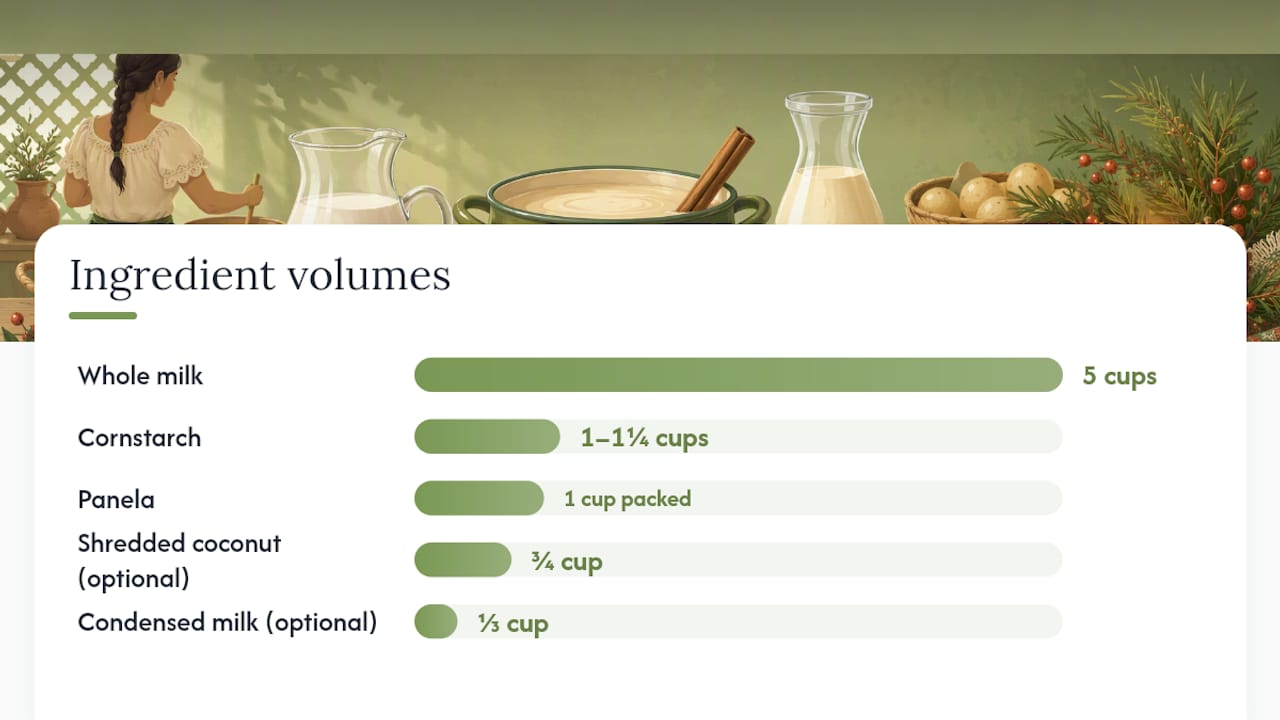
Equipment: a heavy-bottom saucepan (at least 3-quart), a wooden spoon, a fine-mesh sieve, a whisk, and a lightly greased glass baking dish or mold (roughly 8×8 inches).
Panela substitution
Panela is the authentic choice, and its flavor is genuinely different from refined sugar. When it’s not available, The Spruce Eats suggests combining dark brown sugar with a small amount of molasses as an approximation: use 1 cup packed dark brown sugar plus 1 tablespoon molasses to replace 1 cup of panela. The result is close in color and sweetness, though panela’s mineral depth only partially transfers. Treat it as a practical workaround, not an equal swap.
Pro Tip: Grate or finely chop your panela block before adding it to the milk. Whole chunks take much longer to dissolve and can leave uneven sweetness in the finished custard.
How to make natilla on the stovetop
The key is gentle heat, spice-infused milk, and a smooth cornstarch slurry added slowly. Rush any of those three and you get scorched custard or lumps.
- Reserve cold milk for the slurry. Pour 4 cups of milk into your saucepan. Set the remaining 1 cup aside in a bowl at room temperature.
- Infuse the milk. Add the cinnamon sticks and a pinch of salt to the saucepan. Warm over medium heat until the milk just begins to steam, about 5 minutes. Do not boil.
- Add the panela. Stir in the grated panela (or brown sugar + molasses). Keep stirring until fully dissolved, another 2–3 minutes on medium-low heat.
- Make the slurry. Whisk the cornstarch into the reserved cold cup of milk until completely smooth with no lumps. Colombian Recipes emphasizes dissolving cornstarch in cold milk before adding it to the hot mixture — this single step prevents most clumping problems.
- Remove the cinnamon. Fish out the cinnamon sticks before adding the slurry. They’ve done their job.
- Add the slurry slowly. Pour the cornstarch mixture into the warm milk in a thin, steady stream while stirring constantly. Never dump it all at once.
- Cook low and slow. Reduce heat to medium-low. Stir continuously with a wooden spoon, scraping the bottom and sides. Receta Tipica notes that cooking on medium-low with constant stirring for 8–12 minutes after adding the slurry is a common window, though batch size affects timing.
- Check for doneness. Drag your wooden spoon across the bottom of the pot. When the pot bottom stays visible for several seconds before the mixture flows back, the natilla is ready.
- Add butter and optional mix-ins. Stir in the butter off the heat until melted. Fold in coconut, raisins, or nuts if using.
- Pour and set. Transfer immediately to your greased mold. Smooth the surface. Dust lightly with ground cinnamon.
Pro Tip: Stir in a slow, deliberate figure-eight pattern rather than frantic circles. This keeps the mixture moving evenly across the pan bottom and reduces the chance of hot spots forming.
How do you know when natilla is done, and how do you fix common problems?
A properly cooked natilla pulls away from the sides of the pan slightly, holds a thick ribbon when you lift the spoon, and reveals the pot bottom for a few seconds when you drag the spoon across it. If yours doesn’t behave that way, here’s what to do.
Too thin after cooling
The natilla set in the mold but wobbles like gelatin rather than slicing cleanly. This usually means the cornstarch ratio was slightly low or the mixture didn’t cook long enough. Next batch: add an extra tablespoon of cornstarch to the slurry. For the current batch, return it to the pan over low heat, stir in 1–2 tablespoons of cornstarch dissolved in 2 tablespoons of cold milk, and cook another 5 minutes.
Too thick or rubbery
The custard slices but feels dense and bouncy. You likely cooked it past the doneness window or used too much cornstarch. Warm the natilla gently in a double boiler and whisk in a splash of warm milk, a tablespoon at a time, until the texture loosens.
Lumpy or grainy texture
Lumps almost always come from adding the slurry too fast or from cornstarch that wasn’t fully dissolved. The Spruce Eats points to constant stirring over moderate heat as the primary prevention. If lumps appear mid-cook, strain the mixture through a fine-mesh sieve back into the pan and continue cooking.
Scorched or bitter flavor
A slight burnt note at the bottom means the heat was too high or stirring stopped. Carefully pour the unscorched top portion into a clean pan — do not scrape the bottom — and taste. If the flavor is still good, continue cooking in the clean pan.
Pro Tip: Low, steady heat with a rhythmic stir beats high heat every time. Higher temperatures speed up thickening but dramatically increase scorch risk and can leave a bitter aftertaste that no amount of cinnamon will cover.
What variations can you make with natilla?
Traditional panela natilla
The base recipe above is the classic. Panela gives it a dark, caramel-molasses color and a depth that white sugar simply doesn’t produce. This is the version most Colombian families make for Christmas, often in batches large enough to share with neighbors.
Coconut natilla
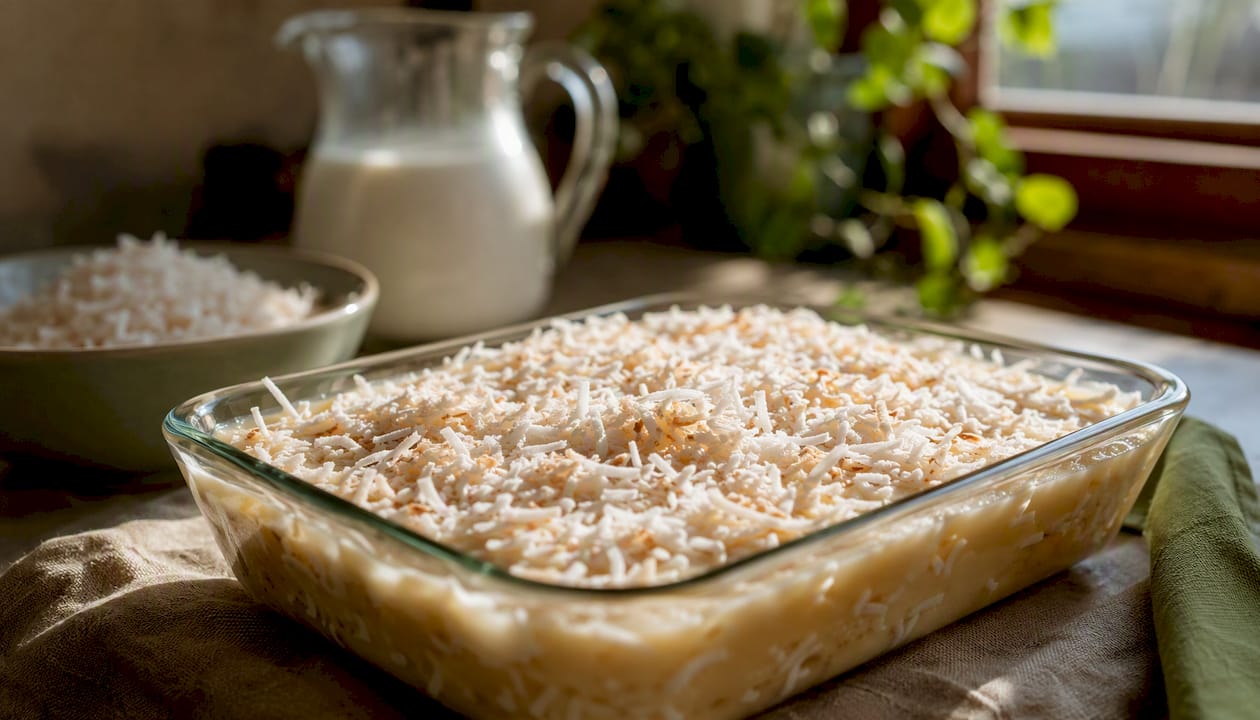
Replace 1 cup of whole milk with 1 cup of full-fat coconut milk, and fold in ¾ cup of grated coconut with the butter at the end. My Colombian Recipes’ coconut natilla notes that coconut milk changes both flavor and cook time — the higher fat content can require a few extra minutes of stirring to reach the same doneness cue.
Condensed milk version
Swap 100 ml of whole milk for condensed milk and reduce the panela by about one-third. The result is noticeably sweeter and slightly creamier. Because condensed milk adds sugar and reduces total liquid, the mixture thickens faster — watch the pot more closely from the 6-minute mark.
Optional additions
- Raisins: stir in ⅓ cup with the butter at the end
- Chopped walnuts or almonds: fold in ¼ cup for texture contrast
- Grated white cheese (queso blanco): a regional addition in some Colombian households; stir in 2–3 tablespoons at the end for a subtle salty note
- Aguardiente: a splash (1 tablespoon) stirred in off the heat adds a faint anise warmth; traditional in some regions
Substitution ratios at a glance:
- Panela → 1 cup packed dark brown sugar + 1 tbsp molasses (approximation only)
- Whole milk → full-fat coconut milk (1:1 for coconut variant)
- Condensed milk → replaces equal volume of whole milk; reduce added sugar by one-third
How to cool, set, and serve natilla
Pour the hot natilla into a lightly greased mold immediately after cooking. Let it sit at room temperature for 1–2 hours before moving it to the refrigerator. My Colombian Recipes explains that this gradual temperature transition prevents surface condensation and the rubbery skin that forms when hot custard hits a cold environment too quickly. Overnight refrigeration gives the cleanest, firmest slices.
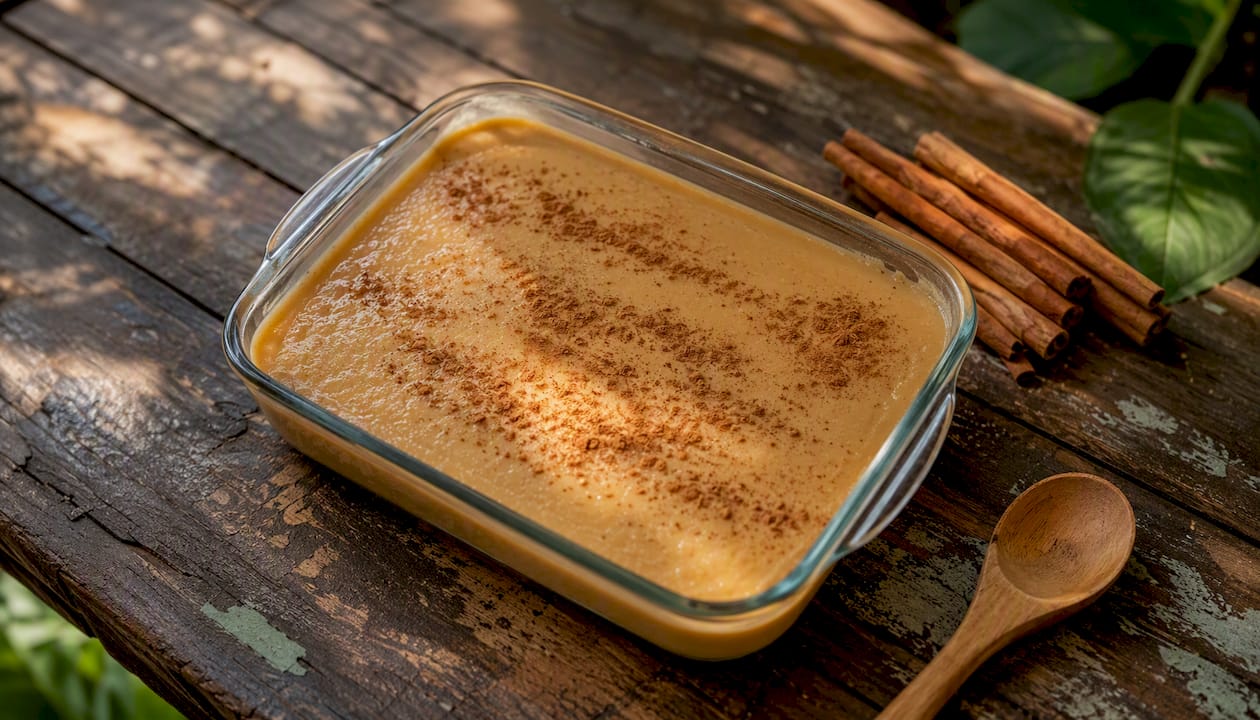
Once set, run a knife around the edges and invert onto a cutting board, or simply cut squares directly in the dish. Dust each piece with ground cinnamon. The classic pairing is buñuelos — fried cheese fritters — served alongside. Fresh fruit works too, especially mango or pineapple, which cut through the richness.
Fridge life: natilla keeps well for 3–4 days covered in the refrigerator. Reheating: warm gently in a double boiler while stirring; microwave reheating tends to create uneven hot spots and can make the texture rubbery. Freezing: not recommended. The cornstarch structure breaks down on thawing, leaving a watery, grainy result.
For individual servings, pour the hot natilla into greased ramekins before it sets. They unmold cleanly and look polished on a holiday table.
A note on natilla’s nutrition
Natilla is a rich, dairy-based dessert. A standard serving (one square, roughly 100–120 g) carries meaningful calories from whole milk, panela, and butter, with the exact amount varying by recipe and portion size. Coconut and condensed-milk variations raise both fat and sugar content further. For precise figures tied to your specific batch and ingredients, a nutrition calculator like Cronometer or the USDA FoodData Central tool gives the most accurate result.
Calorie note: natilla made with whole milk and panela will always be a treat-category dessert. The variation in sweetener, milk fat, and add-ins means no single nutrition figure applies to every version — calculate based on your exact ingredients and portion weight.
Why panela makes the difference in authentic natilla
Panela contributes the characteristic caramel-molasses depth that brown sugar alone doesn’t fully replicate. The difference shows up in both color and flavor: panela produces a darker, more complex custard with subtle mineral notes that come from the unrefined cane juice. Brown sugar has had most of those compounds removed during processing.
The Spruce Eats notes that panela’s mineral and molasses content creates flavor layers that brown sugar alone cannot fully replicate, and that adding molasses to brown sugar helps but remains an approximation.
Sourcing tip: buy panela in a 500 g or 1 kg block, grate or chop it before use, and store it in an airtight container away from moisture. Whole blocks keep for months; pre-grated panela absorbs humidity faster.
For readers outside Colombia, Latin American grocery stores and some health food retailers carry panela. Online is often the most reliable option.
- Look for blocks labeled “panela,” “rapadura,” or “piloncillo” — these are regional names for the same unrefined whole cane sugar
- Organic panela preserves the full molasses and mineral profile; conventional versions vary in processing
- Grate directly into the warm milk for the fastest dissolving
- A 500 g block covers one standard natilla batch; a 1 kg block handles two or a larger holiday quantity
Zestepanela sources organic Colombian panela produced by traditional methods in the Colombian Andes, preserving the natural molasses and minerals that define authentic natilla flavor. You can read more about what panela is and how it’s used on the Zestepanela blog.
A perspective on natilla as a holiday tradition
Natilla isn’t just a recipe — it’s a ritual. My Colombian Recipes and Receta Tipica both describe natilla as Colombia’s quintessential Christmas dessert, prepared in large batches for family gatherings, with the stirring itself shared among family members. That communal element matters. The long, steady stir over a low flame is not just technique — it’s the part of the recipe that requires you to slow down, stay present, and hand the spoon to someone else when your arm gets tired.
What most recipe articles miss is that the “correct” natilla is the one your family makes. Some households add cheese. Some use coconut milk every year. Some skip the raisins entirely. The cornstarch ratio and the low heat are non-negotiable; everything else is yours to adjust. Start with the traditional panela version, get the texture right, then make it your own.
Authentic panela for your natilla
If you want the real caramel-molasses depth in your natilla, the sweetener is where it starts. Zestepanela’s organic panela (500 g) is produced by traditional methods in the Colombian Andes, preserving the natural molasses and minerals that give authentic natilla its characteristic dark color and layered flavor. One 500 g pack covers a standard holiday batch; the 1 kg option works well if you’re making natilla for a larger gathering or want enough left over for coffee and baking through the season.
Order directly from Zestepanela and have authentic organic panela delivered to your door, ready for your next holiday batch.
Sources
These are the recipe and cultural references used throughout this guide.
- Natilla Tradicional Colombiana (Colombian Christmas Sweet Custard) - My Colombian Recipes
- Natilla Colombiana (Colombian Christmas Custard) Recipe - The Spruce Eats
- How to make Natilla or Custard (Delicious Colombian dessert) - Receta Tipica
- Natilla – Classic Colombian Christmas Custard - Colombian Recipes
0 comments