

Store panela at moisture levels typically ranging from low to moderate with a target that prevents microbial spoilage. Granulated panela should be kept with lower moisture than block panela.
- Safe moisture range varies by presentation.
- Critical a_w threshold should be kept below levels that promote microbial growth.
- Immediate action: airtight container and cool, dry location.
- If panela feels sticky or soft on arrival, spread it on a clean tray and let it air dry at room temperature before resealing
Pro Tip: Drop a food-grade silica gel packet into every storage container. It costs almost nothing and keeps the headspace RH low enough to prevent surface stickiness for months.
Key Takeaways
| Point | Details |
|---|---|
| Safe moisture ranges | Keep granulated panela under 5% and block panela under 9% moisture (wet basis). |
| Critical a_w threshold | Water activity above 0.60 enables microbial growth; above 0.70 browning accelerates. |
| Storage essentials | Airtight container, RH below 55%, temperature below 65°F, with silica gel for longer storage. |
| Baking adjustment | Reduce added liquid by 10–15% and lower oven temp by 10–15°F when substituting panela for white sugar. |
| Zeste panela option | Ships in moisture-barrier packaging with lot-tested organic Colombian panela in 500 g, 1 kg, and 25 kg sizes. |
Table of Contents
- Why panela moisture content controls quality, texture, and safety
- What moisture levels look like across panela presentations
- How to measure panela moisture and water activity
- Practical storage and packaging to keep panela stable
- How panela moisture affects your baking
- Recognizing moisture problems and recovering damp panela
- What to check when buying or receiving panela
- The evidence behind these recommendations
- What Zestepanela has learned from sourcing in the Colombian Andes
- Zestepanela’s organic panela, ready to order
- Sources
Why panela moisture content controls quality, texture, and safety
Moisture content and water activity are related but not the same thing. Moisture content tells you how much water is present by weight. Water activity (a_w) tells you how much of that water is available to support microbial growth or chemical reactions. A product can have moderate moisture but low a_w if the water is tightly bound to sugars and minerals. For panela, a_w is the number that actually predicts spoilage risk.
Panela absorbs moisture from the air because it contains sucrose, invert sugars, and minerals, which interact with water differently than refined sugar. Elevated water activity increases risks of microbial growth and browning.
Key figure: Controlled storage trials at 40°C/75% RH showed measurable increases in both moisture and a_w within weeks, producing visible color change and texture softening across all panela presentations tested.
What moisture levels look like across panela presentations
Moisture varies meaningfully by how panela is processed and shaped. Analytical surveys of artisanal and experimental panelas measured group means ranging from roughly 2.17% to 4.33% (g/100 g wet basis), with some experimental lots exceeding regional maximum limits.
These aren’t arbitrary numbers. Block panela’s denser structure limits surface exposure, while granulated panela’s higher surface area makes it absorb ambient humidity faster.
| Presentation | Typical moisture range (wet basis) | Typical a_w range | Regulatory max |
|---|---|---|---|
| Granulated | Low to moderate moisture levels | Moderate water activity | Set by regional standards |
| Block (round or square) | Higher moisture levels than granulated | Slightly higher water activity | Typically within regional limits |
| Artisanal / handmade | Variable moisture levels | Variable water activity | Depends on market standards |
Regional and seasonal variation adds real spread to these numbers. Panela produced during Colombia’s rainy season or in higher-humidity micro-climates tends to arrive with moisture near the upper end of its range. Equilibrium moisture curve analysis covering 13–34°C and RH 60–90% shows that panela produced at typical production moisture (around 8–10% in some regions) will only hold short-term under ambient conditions.
How to measure panela moisture and water activity
Laboratory methods are the gold standard for commercial buyers and food retailers:
- AOAC 925.45 / AACC 44-15.02 (oven drying): Weigh a sample, dry it at 105°C for several hours, and reweigh. The weight loss equals moisture content. Straightforward, inexpensive, and widely accepted for proximate analysis.
- Karl Fischer titration: More precise for low-moisture samples; useful when moisture is below 2% and oven-drying precision is insufficient.
- Water activity meter (e.g., Pawkit or AquaLab): Measures a_w directly in minutes. This is the tool that tells you whether your panela is actually safe from a microbial standpoint, not just how much water it contains by weight. Any commercial bakery or retailer handling bulk panela should own one.
Practical home checks won’t give you a number, but they tell you whether something is wrong:
- Press a finger firmly into block panela. It should feel hard and dry, not yielding or tacky.
- Rub a small amount of granulated panela between your fingers. Clumping or stickiness signals elevated moisture.
- Smell the product. A faint molasses aroma is normal. A fermented, sour, or musty smell is not.
Pro Tip: When testing a block or a large lot, sample from at least three locations: the surface, the center, and a corner. Moisture gradients inside a block can be significant, and a single surface reading will underestimate the true moisture range.
Practical storage and packaging to keep panela stable
Everything else follows from that.
For home bakers:
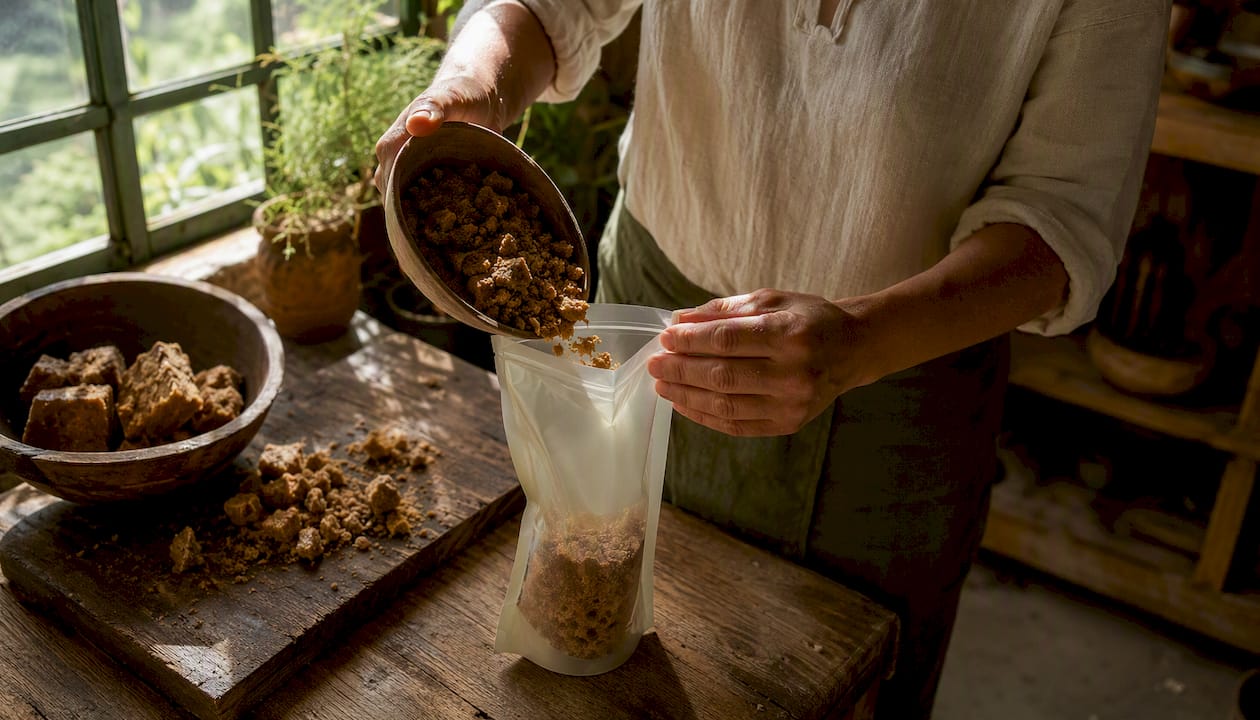
- Transfer panela from its original bag into a glass jar or airtight food-grade container immediately after opening
- Add one food-grade silica gel packet per quart of container volume
- Store away from the stove, dishwasher, or any heat source that cycles humidity
- Check texture monthly; re-dry if stickiness develops
For bakeries and commercial kitchens:
- Store bulk panela in sealed barrier-lined bins, not open sacks
- Maintain storage room at 60–65°F and RH below 55%
- Rotate stock on a first-in, first-out basis; mark receiving dates on every container
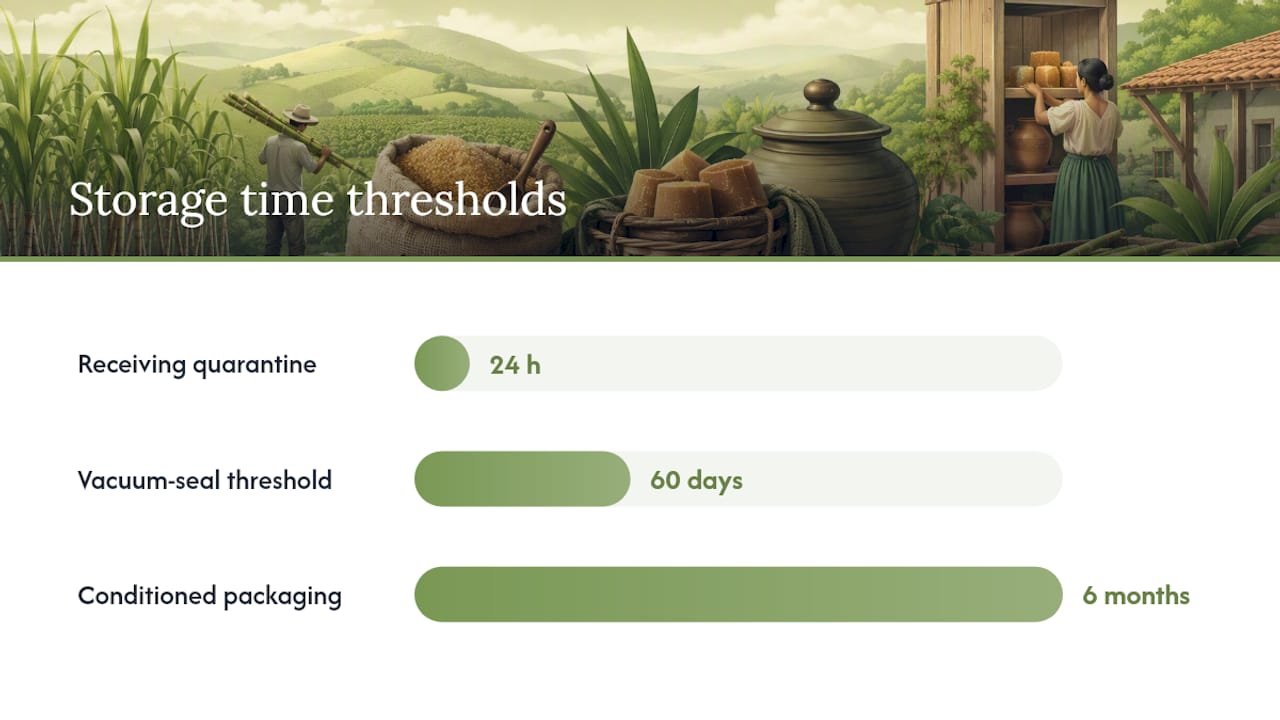
- For long-term stock, vacuum-seal portions you won’t use within 60 days
For retailers receiving wholesale panela:
- Inspect packaging integrity before shelving; any torn or compromised seal warrants moisture testing
- Hold new stock in a quarantine area for 24 hours if the receiving dock is humid; check for stickiness before shelving
- Keep retail display away from refrigerated cases (condensation risk) and direct sunlight
Pro Tip: For storage beyond 6 months, conditioned packaging works better than silica gel alone. Flush the container with dry nitrogen before sealing to displace humid air, then add silica gel as a secondary buffer. This approach is standard in specialty food distribution and extends shelf life significantly.
How panela moisture affects your baking
Panela’s invert sugars and minerals hold more bound water than refined sugar, and that difference shows up directly in your baked goods. Research on jaggery-based baked goods found that muffins made with unrefined cane sugar had 21.8% moisture versus 19.6% for standard sugar muffins. That gap affects crumb texture, browning rate, and shelf life.
Practical adjustments when substituting panela for granulated white sugar:
- Weight swap: substitute panela 1:1 by weight, not by volume. Granulated panela is less dense than white sugar; volume swaps will over-sweeten.
- Reduce added liquid by 10–15% when using panela in batters, since panela contributes more moisture to the mix.
- Watch browning: panela accelerates Maillard reactions. Drop oven temperature by 10–15°F or check for doneness 5 minutes earlier than your recipe specifies.
- Adjust leavening: the slight acidity from panela’s organic acids can interact with baking soda. If your recipe uses baking soda, reduce it by about 10% and test.
Pro Tip: Grate block panela on a microplane or box grater before measuring. Finely grated panela dissolves faster, distributes more evenly, and gives you a more consistent moisture contribution than rough chunks do. Warm the block briefly (under 65°C) if it’s too hard to grate cleanly.
Recognizing moisture problems and recovering damp panela
Signs that moisture has become a problem:
- Surface feels tacky or leaves residue on fingers
- Granulated panela has clumped into a solid mass
- Color has darkened unevenly or developed a grayish cast
- Smell has shifted from caramel-molasses to sour, fermented, or musty
When to remediate vs. when to discard:
- Sticky or clumped panela with no visible mold and no off-odor: recoverable
- Any visible mold (white, green, or black spots): discard immediately. Do not attempt to scrape off mold and use the rest. Mold on a high-sugar substrate can produce mycotoxins that penetrate beyond the visible growth zone.
- Fermented or sour smell without visible mold: discard. Yeast activity at elevated a_w has already altered the product.
Remediation steps for recoverable product:
- Remove panela from its container and spread it in a thin layer on a clean, dry baking sheet.
- Place in an oven at the lowest setting (ideally 100–120°F) with the door slightly ajar for 30–45 minutes.
- Let it cool completely at room temperature before tasting or testing texture.
- If texture has returned to firm and dry, repackage immediately with fresh silica gel.
- Use remediated product within 30 days and do not attempt a second drying cycle.
What to check when buying or receiving panela
On-arrival checks for home buyers:
- Packaging is intact with no tears, moisture stains, or swelling
- Product feels firm and dry through the bag
- No off-odors when the bag is opened
- Lot number and production date are visible
For wholesale and retail buyers:
- Request the processing date, origin traceability documentation, and certified organic status before accepting a shipment
- Ask the supplier for storage conditions during transit (temperature and RH logs if available)
- Sample at least 3–5 units per pallet for moisture and a_w testing before shelving
- If ambient humidity at receiving is above 70% RH, hold the shipment in a climate-controlled area for 24 hours before inspection
The 25 kg wholesale format from Zestepanela ships in barrier packaging designed to limit moisture ingress during transit, which simplifies the receiving process for high-volume buyers.
The evidence behind these recommendations
The guidance in this article draws on four categories of evidence:
- Controlled storage trials at 30°C/75% RH (ambient) and 40°C/75% RH (accelerated) tracking moisture, a_w, color, and texture changes over 129 days, with kinetic modeling to project shelf life at 25°C.
- Proximate analysis of artisanal and experimental panela lots using AOAC and AACC standard methods for moisture, ash, sucrose, and invert sugar content.
- Equilibrium moisture curve modeling across temperature and RH ranges representative of tropical production and temperate storage environments.
- Applied food science literature on unrefined cane sugar baked goods, including comparative moisture and texture data.
Shelf-life projections (such as the ~398-day estimate for round block panela at 25°C) come from accelerated storage modeling and apply to the specific lots tested. Your results will vary with actual storage conditions and product moisture at purchase.
This article is general guidance, not regulatory compliance advice. For jurisdictional standards, consult Colombian NTC/MinSalud Resolution 779/2006, USDA organic certification requirements, or your applicable food safety authority.
What Zestepanela has learned from sourcing in the Colombian Andes
Sourcing organic panela directly from traditional producers in the Colombian Andes means we see moisture variability firsthand. Harvest season, altitude, and the specific trapiche (small-scale mill) all shift the moisture profile of each lot. That’s why we test every shipment before it ships and package in sealed, moisture-barrier bags designed to hold product stable through U.S. transit.
If you’ve ever opened a block and found small hard pieces or an uneven texture, our guide to hard pieces in panela explains exactly what’s happening and why it’s a normal feature of artisanal production, not a defect. For wholesale accounts, we’re happy to share lot-specific moisture data and storage recommendations. Reach out through the contact page and we’ll get you what you need.
Zestepanela’s organic panela, ready to order
Zestepanela’s organic Colombian panela ships in moisture-barrier packaging that keeps a_w stable from the Andes to your kitchen. For home bakers, the 500 g pack is the right starting size: enough to test panela in your recipes without committing to bulk storage. Regular bakers and small cafés will find the 1 kg format more economical and still easy to store airtight at home. High-volume buyers, including retailers and food service operations, can order the 25 kg wholesale bag, which comes with storage guidance and is available with wholesale account pricing. Contact us directly for custom packaging, pallet orders, or lot-specific moisture documentation.
Sources
- Pmc
- Physical and chemical properties of granulated cane sugar “panelas”
- Evaluación termodinámica de variables críticas en la Estabilidad de la panela de caña de azúcar
- Equilibrium humidity determination in molases (panela) | Agronomía Colombiana
0 comments