

Panela keeps for months, often well over a year, if you control one variable: humidity. A sealed block stored somewhere cool and dry can hold up for many months or longer, while granulated panela left in a damp kitchen can clump and lose quality more quickly. The number that actually matters isn’t a date on a label. It’s water activity, the measure of how much moisture is free to move inside the product and feed chemical or microbial change.
Target a storage relative humidity below a moderate threshold. Above that, panela pulls moisture from the air, softens, clumps, and eventually darkens faster than it should.
Do these three things today and you’ve handled most of what causes premature spoilage:
- Move panela into an airtight container, glass jar, or resealable bag with the air pressed out.
- Store it somewhere cool and dark. Pantry shelves away from the stove or a sunny window work fine.
- Keep it away from steam, open humidity, or anywhere condensation collects, like near a dishwasher or sink.
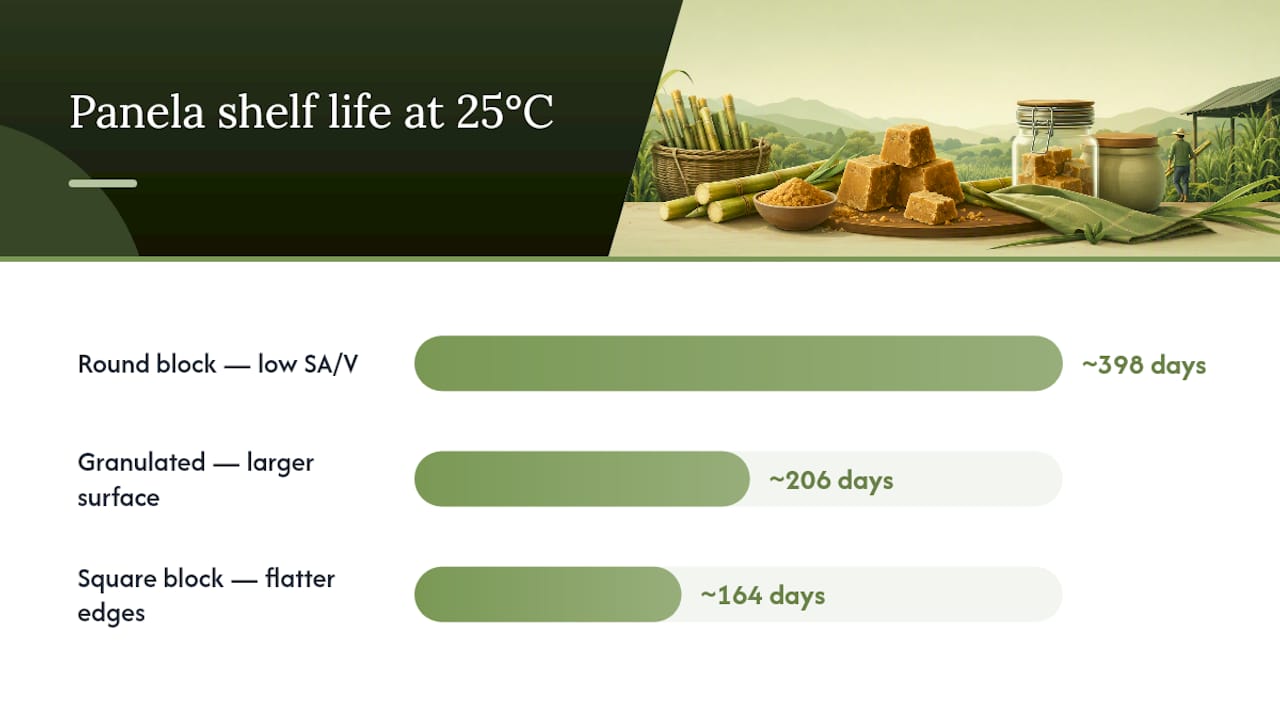
Quick fact: A controlled 129 day storage study tracking moisture, sugar content, and water activity in three panela formats found the round block projected to remain stable for roughly 398 days at 25°C, compared with about 206 days for granulated and 164 days for square blocks under the same modeled conditions.
Key Takeaways
Panela’s shelf life depends far more on how you store it than on how long ago it was packed, and controlling humidity is the single lever that protects both flavor and safety.
| Point | Details |
|---|---|
| Humidity is the real enemy | Keep storage relative humidity below roughly 55% to limit moisture uptake and clumping. |
| Format changes the timeline | Round blocks resist moisture longest, followed by granulated, then square blocks, per kinetic modeling. |
| Treat estimates as best-before | Shelf-life numbers assume 25°C and low humidity; real conditions shift the actual timeline. |
| Fix, don’t discard, most issues | Grating, gentle heat, or a bread slice trick revives hardened or clumped panela safely. |
| Choose format by turnover | Zestepanela’s 500g, 1kg, 5kg, and 25kg packs are sized so panela gets used before quality fades. |
Table of Contents
- What Determines How Long Panela Lasts?
- How Long Does Each Panela Format Actually Last?
- How Should You Store Panela at Home or in a Café?
- What If Your Panela Hardens, Clumps, or Softens?
- Best-Before vs. Use-By: What Should the Label Say?
- Why Do Two Panela Brands Claim Different Shelf Lives?
- What a Panela Specialist Actually Watches For
- Which Zesté Panela Format Should You Choose?
- Sources
What Determines How Long Panela Lasts?
Water activity, written as aw, measures the fraction of water in a food that’s actually free to move and support chemical or microbial activity, as opposed to water bound tightly to sugars and minerals. It’s not the same thing as the relative humidity of the room panela sits in, though the two are connected: high ambient RH pushes moisture into the product over time, and that raises its internal aw. Practical guidance on panela and piloncillo storage treats an aw around 0.55 or below as the threshold that supports long microbiological stability in unrefined sugars, and foods generally resist mold growth once aw drops under about 0.7.
Temperature speeds up whatever direction the moisture is already heading. Warm, humid storage accelerates both microbial risk and the Maillard browning that darkens panela naturally over time, a cosmetic and flavor shift rather than a safety issue.
Physical form matters more than most people expect. A round or square block has far less surface area exposed to air than the same weight of granulated panela, so it absorbs ambient moisture more slowly. That’s a big part of why blocks tend to outlast granulated product in identical storage conditions, an effect the kinetic modeling behind the 129 day study attributes largely to surface-area-to-volume differences between presentations.
Panela’s molasses content adds another layer. Because it retains the minerals and molasses stripped out of refined white sugar, panela behaves differently under humidity than the white sugar in your pantry, dissolving faster in liquid but also clumping faster in damp air.
Pro Tip: If you live somewhere humid, a $5 hygrometer in your pantry tells you more about your panela’s future than any expiration date ever will.
How Long Does Each Panela Format Actually Last?
Shelf-life numbers only mean something once you know the conditions behind them. Here’s what the research shows for panela stored at 25°C and low relative humidity, drawn from a kinetic model that tracked moisture and water activity changes over 129 days of controlled storage.
| Format | Modeled shelf life at 25°C | Why |
|---|---|---|
| Round block | ~398 days | Lowest surface-area-to-volume ratio; slowest moisture uptake |
| Granulated | ~206 days | Larger surface area speeds moisture absorption despite smaller particle size |
| Square block | ~164 days | Flatter geometry and sharper edges expose more surface than round blocks |
Those figures come from thermodynamic and kinetic analysis of water activity in commercial samples, not a fixed expiration clock. The study’s own caveats matter here: these are predictions extrapolated from an accelerated model, not a guarantee that every square block on a store shelf hits exactly 164 days and falls apart. Real-world results shift with packaging quality, regional climate, and how well a retailer or home cook actually maintains dry storage.
Treat these ranges as a best-before window for quality, not a use-by cliff. A block that’s beyond its predicted range isn’t automatically unsafe. It may just need a little extra work to use, which we’ll get to shortly. Consumer storage guides generally echo the same order of magnitude, citing well-stored blocks lasting a year or more at room temperature, with granulated forms trailing behind unless kept in a genuinely airtight container.
How Should You Store Panela at Home or in a Café?
Storage technique should match the format you bought. Here’s the practical sequence:
- Pick the right container. Glass jars with rubber gaskets or heavy resealable bags beat thin plastic sleeves or the paper wrap panela sometimes ships in.
- Find a cool, dark spot. Pantry shelves away from the oven, stovetop, or a west-facing window keep both temperature and light swings to a minimum.
- Add a moisture buffer for bulk stock. A food-safe silica packet or a vacuum-sealed bag makes a real difference for anything beyond a single household-size block, a step storage guides recommend specifically for extending time in humid climates.
- Portion granulated panela into smaller jars. Opening one big container repeatedly exposes the whole batch to fresh humidity every time. Smaller daily-use jars protect the bulk supply.
- Reserve the fridge or freezer for long horizons. Room temperature and low humidity beat refrigeration for regular use, but freezing works for stockpiling months of supply, particularly for granulated panela you won’t touch again soon.
Retailers and café buyers face a slightly different problem: bulk product moving through more hands and more open air. Transfer large blocks into oxygen and moisture barrier packaging as soon as a bulk case is opened, rather than leaving it in its shipping box on a back shelf. Label each batch with a receipt date and rotate stock on a first in, first out basis, the same discipline any perishable dry good deserves. For wholesale volumes, vacuum sealing or shrink wrap around individual blocks is one of the simplest interventions available, and it’s cheap insurance against the humidity swings a busy kitchen generates.
Pro Tip: Buying panela in bulk for a café? Repackage into weekly-use portions the day it arrives. The bag or block you keep sealed in the back stays stable far longer than the one that gets opened and closed all shift.
What If Your Panela Hardens, Clumps, or Softens?
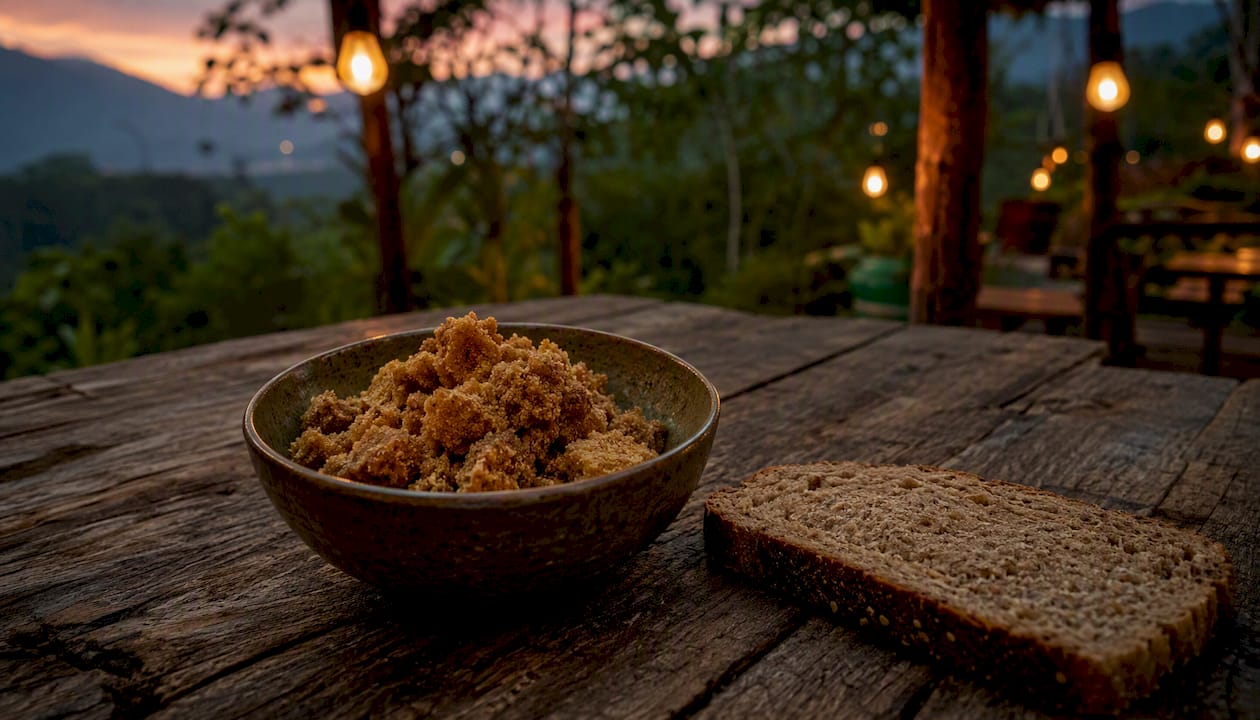
Hardened blocks and clumped granulated panela are almost always fixable, not spoiled. A block gone rock-solid can be softened with a few seconds in the microwave, a brief stint in a warm oven, or by grating it directly into whatever you’re cooking, since grated panela dissolves fast regardless of how firm the block got. Granulated panela that’s clumped from ambient moisture responds well to an old bakery trick: drop a slice of bread or a terracotta brown sugar saver into the container for a day or two, and the panela draws just enough moisture to loosen back into workable granules.
A chalky white bloom on the surface of a block is usually harmless sucrose crystallizing out, sometimes called sugar bloom, and it’s a cosmetic issue rather than a safety one. It doesn’t mean the panela has gone bad, and Zestepanela’s own notes on hard pieces and crystallization walk through exactly why that texture shows up.
What genuinely signals spoilage is a different set of clues entirely.
- A sharp vinegary, fermented, or musty smell that wasn’t there before.
- Surface tackiness or visible droplets “weeping” out of the block.
- Any fuzzy or colored mold growth, however small.
Fuzzy mold growth or a fermented odor means the product should be discarded, not cooked around. Boiling or baking doesn’t destroy the mycotoxins some molds leave behind, so heat isn’t a fix once contamination is visible.
Don’t assume boiling makes a moldy product safe again, and don’t confuse ordinary crystallization with the beginning of decay. They look different once you know what to check for.
Best-Before vs. Use-By: What Should the Label Say?
Panela almost always ships with a best-before date rather than a use-by date, and the distinction matters more than most shoppers realize. A use-by date is a safety cutoff, common on fresh perishables where bacterial risk climbs sharply past a certain point. A best-before date is a quality claim: past that point, the product may darken, harden, or lose some aromatic complexity, but it isn’t inherently unsafe the day after.
That’s the right framing for a low-moisture, high-sugar product like panela, where the dominant risks are texture and flavor drift rather than pathogen growth.
For retailers, a useful label carries more than just a date:
- Batch or production date, so staff can track rotation without guessing.
- Recommended storage conditions (cool, dry, sealed) printed directly on the pack.
- Format called out clearly (block vs. granulated), since shelf-life expectations differ between them.
- Display guidance keeping stock off direct sunlight and away from any source of ambient steam, like a coffee bar’s espresso machine.
Run FIFO rotation on shelved stock, and if you’re breaking down a wholesale case into smaller retail units, do it into barrier packaging rather than open bins. A quick staff briefing on what harmless crystallization looks like versus real spoilage saves you from tossing perfectly good stock out of caution.
Why Do Two Panela Brands Claim Different Shelf Lives?
Two bags of panela sitting side by side on a shelf can carry genuinely different shelf-life expectations, and it isn’t marketing spin. Origin, ash and mineral content, moisture level at the moment of packing, and even the specific mold used to shape a block all shift how a product ages. Regional variants show measurably different ash and moisture percentages, which explains why one producer’s block might feel noticeably drier or denser than another’s straight out of the package. Zestepanela has covered why texture varies between batches for exactly this reason.
You don’t need a lab to make a reasonable call on a given block or bag. A quick look, sniff, and touch test tells you most of what you need:
- Look: a chalky white surface bloom is fine; fuzzy spots or discoloration patches are not.
- Smell: a warm, molasses aroma is normal; anything sour, musty, or fermented is a red flag.
- Touch: hard is fixable; tacky or wet to the touch is a warning sign.
A water activity meter is the only way to get a precise number, and it’s worth the investment for a retailer moving serious volume, but most home cooks and small shops can make a confident call with sensory checks alone, paired with a rough sense of how humid the room has been.
What a Panela Specialist Actually Watches For
Format drives most of the storage advice we give customers, and it’s the first question worth asking before anything else. A round block moving through a busy café kitchen behaves differently than the same weight of granulated panela sitting in a home pantry for six months.
We ship panela in formats built around how people actually use it: a 500 gram pack sized for a household that goes through panela steadily but not fast, a 1 kilogram option for bakers and café staff running through more volume, and 5 kilogram and 25 kilogram formats for wholesale accounts that need bulk without babysitting an open box daily. Every format ships sealed to keep ambient moisture out from the moment it leaves the production facility until someone opens it, because the packaging decision is really a shelf-life decision made before the product ever reaches a shelf.
The one habit I’d push every customer toward, home cook or café manager alike: portion out what you’ll use in a week or two into a smaller sealed container, and leave the bulk pack closed as much as possible. Every time a big container gets opened, it takes on a little humidity from the room. Minimizing those openings is a bigger lever than almost anything else you can do after purchase.
Which Zesté Panela Format Should You Choose?
If you’ve read this far, you know the two things that actually protect panela: low humidity exposure and the right format for how fast you’ll use it. That second point is where picking the right pack size pays off. Buying a 25 kilogram wholesale block you’ll take three months to work through defeats the purpose of tight packaging, while a home cook restocking every few weeks doesn’t need bulk at all.
Zestepanela sells panela in sizes matched to real usage patterns rather than one-size-fits-all packaging. The 500 gram retail pack suits home cooks and bakers who want a resealable, manageable portion that won’t sit open for months. The 1 kilogram pack fits cafés and frequent bakers who move through panela fast enough that a bigger format still gets used before quality drifts. For wholesale buyers and high-volume kitchens, the 5 kilogram and 25 kilogram formats come sealed to limit the moisture exposure that undercuts bulk stock the fastest. Pick the size that matches your actual turnover, not your ambition, and order directly from the product page for your format.
Sources
- Evaluación termodinámica de variables críticas en la Estabilidad de la panela de caña de azúcar
- Spice Hunting Piloncillo Panela Mexican Raw Sugar How to Use
- How to Store Panela or Piloncillo at Home •【 2026 】
- Panela: The Ultimate Guide to This Natural Sweetener
0 comments