

In this guide, “sustainable sugar” means organic panela, unrefined whole cane sugar made by a method the FAO classifies as non-centrifugal cane sugar, or NCS. It is our recommended alternative to refined white sugar for anyone cooking, baking, or stocking a menu with sustainability in mind. A case study on organic panela production in Nocaima, Colombia found the organic method cut water use by roughly 72% compared with conventional processing, and a systematic review confirms researchers are still building the human-trial evidence for its health claims. For a ready-to-buy option, Zesté Panela sells organic, non-GMO panela sourced from smallholder producers in the Colombian Andes.
- Bottom line: choose organic, traceable panela over refined sugar when sustainability and flavor both matter.
- Evidence base: strong on environmental footprint and mineral composition, thin on clinical health outcomes.
- Where to start: Zesté Panela’s granulated and block formats cover home, café, and wholesale needs.
Key Takeaways
Organic panela cuts water and fuel use in production while retaining minerals and polyphenols that refined sugar loses, making it the strongest sustainable sugar choice for kitchens today.
| Point | Details |
|---|---|
| Definition matters | “Sustainable sugar” here means organic, non-centrifugal panela, not industrial sugarcane certification schemes. |
| Environmental case is strong | Organic panela production cut water use by about 72% in a documented Colombian cooperative case study. |
| Health claims stay modest | A systematic review found limited human trial evidence, so market panela on flavor and sourcing, not health cures. |
| Format drives use | Granulated panela suits baking and beverages; blocks suit syrups and slow-melt sauces. |
| Zesté Panela covers all sizes | Organic, non-GMO panela in 500g, 1kg, and 5kg formats fits home cooks through wholesale accounts. |
Table of Contents
- What Is Panela and How Is It Made?
- What Does the Research Actually Say About Panela’s Sustainability?
- How Do You Substitute Panela for White Sugar in Recipes?
- How Do You Choose a Genuinely Sustainable Panela Supplier?
- What Does Panela Production Mean for Producer Communities?
- Why Is Scaling Sustainable Panela Production So Difficult?
- Why We Choose Panela for Real Cooking, Not Just Marketing
- If You’re Ready to Buy Organic Panela
- Frequently Asked Questions
- Sources
What Is Panela and How Is It Made?
Panela is unrefined cane sugar made by pressing sugarcane, then boiling and evaporating the juice until it concentrates into a solid or granular form. Nothing gets spun out in a centrifuge, which is exactly what separates it from refined white sugar and even from raw sugar sold at most grocery stores. That’s the technical distinction behind the FAO’s NCS classification, and it’s why panela keeps its molasses, minerals, and color instead of ending up stripped and bleached.
The process runs in a few stages: cane gets pressed for juice, the juice is clarified to remove plant solids, then it’s boiled down in open pans (traditionally over bagasse fires) until it thickens. From there it’s either poured into molds to harden into blocks and cones, or agitated as it cools to form granules.
Format matters more than most cooks expect. Granulated panela dissolves faster, measures more consistently by volume, and stores more predictably than blocks, based on analyses of artisanal granulated panela. Blocks hold flavor intensity well for syrups but need extra prep work before they’ll dissolve into a batter.
- Blocks and cones: best for syrups, sauces, and slow-dissolve applications.
- Granulated: best for baking, dry mixes, and coffee service where consistency counts.
- Moisture content varies batch to batch with traditional production, which is worth knowing before you standardize a recipe around it.
Pro Tip: If a recipe calls for exact sugar weight, always convert panela by grams rather than cups. Its moisture content shifts volume measurements more than refined sugar’s does.
What Does the Research Actually Say About Panela’s Sustainability?
The strongest evidence for panela’s environmental case comes from a single, detailed case study, not a broad industry survey, and that distinction matters for how confidently you can generalize it. Researchers tracking organic panela production through ASOPROPANOC in Nocaima, Colombia found the switch to organic methods reduced water consumption by around 72%, cut fuel use per kilogram by 50% to 150%, and lowered greenhouse gas emissions somewhere between 1% and 91%, depending on the specific input measured. Yields improved noticeably, though it took a higher upfront investment to get there. Profits also rose, which suggests the tradeoff paid off for that cooperative even before counting environmental gains.
The wide range in the ASOPROPANOC findings, from a 1% to a 91% reduction in emissions, is a reminder that “organic” doesn’t produce one fixed environmental number. It reflects a spread across different inputs and farm conditions, not a single guaranteed outcome.
On nutrition, panela’s advantage over refined sugar is compositional, not miraculous. Because it keeps the molasses that refining strips away, it carries measurable minerals, including potassium, calcium, iron, and magnesium, along with polyphenols, according to a 2022 review of non-centrifugal sugar products. A separate analysis of granulated artisanal panela confirmed detectable levels of potassium, calcium, phosphorus, magnesium, sodium, iron, manganese, zinc, and copper, alongside its dominant sucrose content.
Here’s the caveat that matters most for anyone making health claims on a menu or product label: a systematic review of intervention studies on unrefined sugar and inflammation found the human evidence is limited and mixed, built mostly from in vitro work, animal studies, and small human trials. The reviewers explicitly called for better-designed human trials before anyone draws firm clinical conclusions.
Pro Tip: Market panela on flavor, traceability, and environmental footprint. Avoid framing it as a health food. The mineral content is real but modest, and it’s still sugar metabolically.
How Do You Substitute Panela for White Sugar in Recipes?
Panela swaps into most recipes at a 1:1 weight ratio for white sugar, though its flavor runs deeper and slightly less sweet cup for cup, so some bakers nudge the quantity up 10% to match perceived sweetness. Because it holds moisture and molasses, expect faster browning in baked goods and a denser, chewier crumb in cookies and cakes.
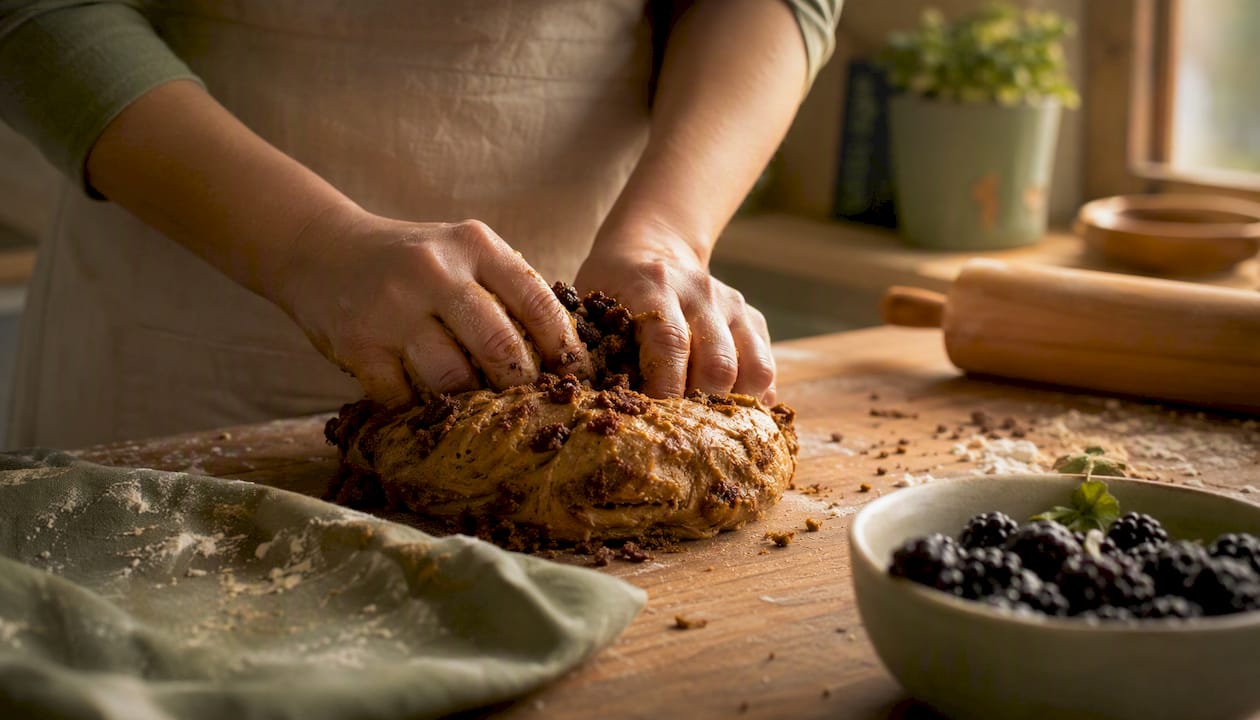
Grated or finely chopped panela blends into batters more evenly than large chunks. For syrups, sauces, and glazes, melt block panela directly with a bit of water over low heat rather than trying to dissolve it cold. Granulated panela works better in dry mixes, spice rubs, and as a coffee sweetener where you want quick, even dissolving.
| Use case | Best format | Notes |
|---|---|---|
| Baking (cookies, cakes) | Granulated | Faster incorporation, more even browning |
| Syrups and glazes | Block, melted | Deeper caramel notes, better for sauces |
| Coffee and beverages | Granulated | Dissolves quickly, consistent sweetness |
| Savory marinades | Block, grated | Complex flavor balances acidity and heat |
Panela’s caramel and toasted-sugar notes make it a natural fit for coffee drinks, glazes on roasted vegetables, and savory-sweet marinades, a versatility food writers have long noted when comparing raw cane sugars to refined white sugar.
- Grate hard blocks with a box grater rather than cutting them with a knife.
- For stubborn blocks, a 10 to 20 second microwave burst softens the surface enough to grate safely.
- Store grated panela in an airtight container; it clumps fast once exposed to humid air.
Pro Tip: Keep a small jar of pre grated panela next to your coffee station. It saves service time and avoids chipping a knife on a hardened block.
For a deeper look at how panela is finding its way onto café menus, see this overview of panela’s growing popularity in cafés and restaurants.
How Do You Choose a Genuinely Sustainable Panela Supplier?
Certification is the first filter, but it’s not the only one. Organic certification confirms farming practices meet a defined standard; it doesn’t automatically confirm fair labor practices or transparent sourcing, so treat it as a starting point rather than a full guarantee.
What to check before buying:
- Organic certification from a recognized body, listed clearly on packaging or the supplier’s site.
- Named origin: a specific municipality or producer association, not just “Colombia” or “South America.”
- Product form matched to your use case: granulated for consistency, blocks for syrups and slow-melt applications.
- Lot consistency, since traditional production naturally varies more than industrial refining.
- Explicit water or emissions data, if the supplier makes environmental claims, rather than vague “eco friendly” language with nothing behind it.
Producer associations like ASOPROPANOC illustrate what real traceability looks like: named cooperatives, documented production methods, and measurable outcomes tied to a specific place and process, not a marketing slogan.
Ask your supplier these three questions:
- What clarification agents are used during processing, if any?
- Does the supplier test batches for consistency, and can they share lot data?
- Do they offer origin documentation or a traceable supply chain story?
For storage, keep panela cool and dry, away from direct humidity. Blocks hold up longer than granulated forms once opened, since granules have more surface area exposed to moisture. Bulk sacks for wholesale accounts should stay sealed until use and get moved through inventory within a reasonable window since flavor gradually mellows over long storage.
Pro Tip: If you’re buying in bulk for a café, ask about minimum order quantities and lead times before committing. Traditional production runs on smaller batches than industrial sugar refining, so supply timing needs more planning.
You can also read more about texture variation in why panela sometimes has hard pieces, a common question from first-time buyers.
What Does Panela Production Mean for Producer Communities?
Panela production remains deeply tied to smallholder and family-run operations, particularly through small mills known as trapiches that have supplied local and regional markets for generations. When a cooperative like ASOPROPANOC shifts toward organic methods, the economic effects ripple beyond the environmental numbers: profits rose about 16% for that group even after accounting for the higher upfront investment organic certification demanded.
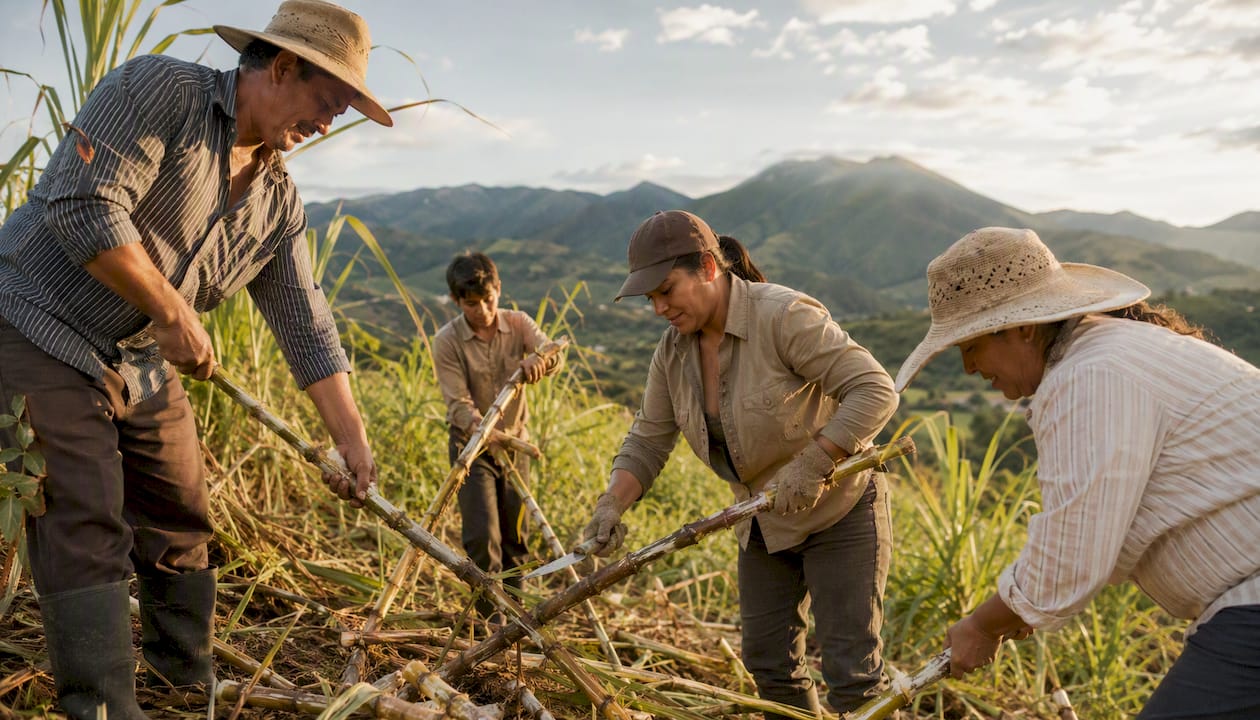
That kind of margin improvement matters more in panela-producing regions than it would in a large industrial sugar operation, because panela income often supports entire rural households rather than shareholders. Buying from associations rather than anonymous bulk suppliers tends to route more of the purchase price back to the people actually growing and processing the cane.
Higher investment requirements for organic certification can also filter out the smallest producers who lack access to credit, a real tension between sustainability standards and inclusive growth. Cooperative models help offset this by pooling resources and sharing certification costs across members, letting smaller growers participate in premium markets they couldn’t access alone.
For buyers, this means a sourcing decision carries weight beyond the kitchen. Choosing panela tied to a named producer association, rather than an unlabeled bulk import, supports the kind of transparent supply chain that keeps traditional production viable instead of getting priced out by industrial sugar.
Why Is Scaling Sustainable Panela Production So Difficult?
Panela’s biggest strength, its small-batch, traditional production model, is also its biggest scaling obstacle. Trapiches vary widely in furnace efficiency and evaporation technology, and engineering assessments of panela production note that upgrades like steam or vacuum evaporators and better heat exchangers can improve yield and reduce unwanted compounds, but adopting that equipment costs money most small producers don’t have on hand.
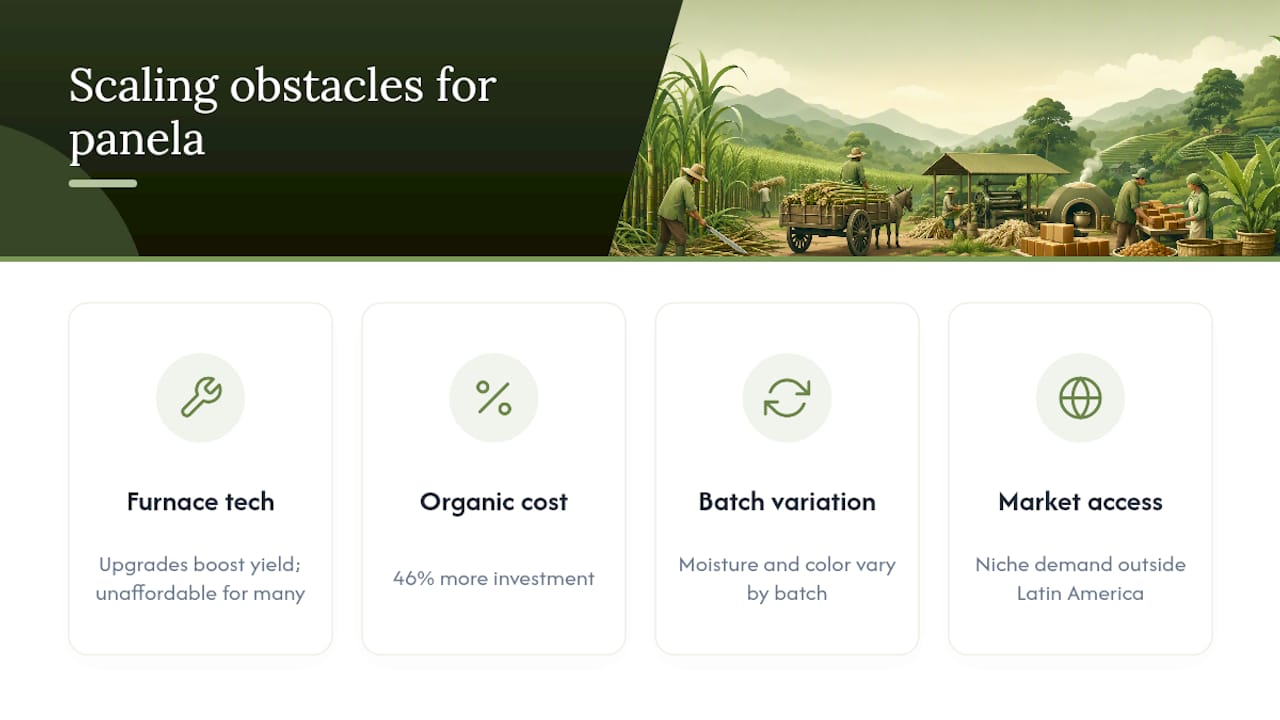
Organic certification adds another layer of difficulty. The Nocaima case study found organic conversion required about 46% more investment, a jump that’s manageable for a supported cooperative but a real barrier for an individual grower without financing.
Consistency is the third obstacle, and it’s the one buyers feel most directly. Traditional evaporation naturally produces batch-to-batch variation in moisture and color that an industrial refinery would never tolerate. That variation is part of panela’s character, but it complicates wholesale contracts that expect uniform specifications.
Market access rounds out the list. Panela still reads as a regional or niche product in many markets outside Latin America. This limits the price premium producers can command even when their environmental and quality metrics genuinely justify one. Building buyer awareness, the kind this guide is part of, matters as much as improving the equipment in the mill.
Why We Choose Panela for Real Cooking, Not Just Marketing
Panela earns its place in a kitchen because of what it does to flavor, not just what it says on the label. Its caramel depth balances acidity in marinades and rounds out coffee drinks in ways refined sugar simply can’t replicate. Fewer substitution headaches come from that same complexity, since one ingredient handles jobs that might otherwise need sugar plus a separate flavor additive.
The sustainability case reinforces a decision we’d make on taste alone. Knowing that organic, cooperative-based production supports smallholder communities and measurably reduces resource use makes it easier to put panela on a menu with confidence, not just enthusiasm.
If You’re Ready to Buy Organic Panela
There are other ways to source unrefined cane sugar, from specialty importers to bulk international suppliers, but most of those options leave you guessing about origin, certification, or consistency between shipments. Zestepanela sells organic, non-GMO panela sourced directly from smallholder producers in the Colombian Andes, with sizing built around how you actually use it.
Home cooks and gift buyers usually start with the 500g pack, which is enough to test a few recipes without committing to bulk. Cafés and small kitchens that go through panela regularly tend to land on the 1kg option, a size that balances shelf life against restocking frequency. Retailers and larger kitchens can move to 5kg bulk packaging, with wholesale accounts available for higher volumes and longer lead times.
Every size ships the same organic-certified, traceable product with no filler ingredients. If you want to see how the granulated format performs against blocks before deciding, check the full product range and pick the size that matches your kitchen’s pace.
Frequently Asked Questions
Is panela actually healthier than white sugar? Panela retains minerals and polyphenols that refined sugar loses during processing, but it’s still sugar metabolically. A systematic review found limited human trial evidence for specific health benefits, so treat it as a more nutrient-retentive option, not a health food.
How do I substitute panela for white sugar in a recipe?
What’s the difference between block and granulated panela? Granulated panela dissolves faster and measures more consistently, making it better for baking and beverages. Block panela holds flavor intensity well and works best melted into syrups, sauces, and glazes.
How can I tell if a panela supplier is genuinely sustainable? Look for organic certification, a named producer origin or association, and explicit data behind any environmental claims. Vague “eco friendly” language without specifics is a signal to ask more questions.
How should I store panela to keep it fresh? Keep it cool and dry, away from humidity. Blocks stay fresh longer than granulated panela once opened, since granules have more surface area exposed to moisture.
This article is general information, not a substitute for advice from a qualified doctor. Consult a qualified healthcare professional about your own circumstances before acting on anything here.
Sources
- The Effect of Unrefined Sugar on Inflammation: A Systematic Review of Intervention Studies - PMC
- Technical, economic, social, and environmental implications of the organic panela production in Nocaima, Colombia: The ASOPROPANOC case
- Occurrence and composition review of non-centrifugal sugar products (DOI:10.3390/app12010460)
- Physical and chemical properties of artisanal granulated panelas and an experimental panela
0 comments