

Unrefined cane sugar is whole cane sugar made by evaporating sugarcane juice until the natural molasses, minerals, and flavor compounds remain intact. Nothing is spun out, bleached, or stripped. The result is a darker, more complex sweetener than anything in the white sugar aisle. That said, it is still predominantly sucrose and still raises blood glucose the same way refined sugar does. The Australian Dietary Guidelines and Food Standards Australia New Zealand (FSANZ) classify it as an added sugar, which means it belongs in your pantry as a flavor tool, not a health supplement.
Key Takeaways
Unrefined cane sugar delivers genuine flavor complexity and trace minerals that refined sugar lacks, but it remains an added sugar with the same blood glucose impact.
| Point | Details |
|---|---|
| What it is | Whole cane sugar made without centrifugation; molasses, minerals, and flavor stay intact. |
| Health framing | Still an added sugar; raises blood glucose the same way as white sugar; use sparingly per Australian Dietary Guidelines. |
| Best culinary uses | Panela for drinks and Latin recipes; muscovado for chocolate and BBQ; jaggery for South Asian cooking; gula melaka for Malaysian desserts. |
| Buying in Australia | Look for “panela,” “rapadura,” or “non-centrifugal” on the label; prefer certified organic and Fairtrade; check health food stores or buy online. |
| Storage | Airtight container, cool and dry; granulated keeps 12–24 months; clumping is normal and not a defect. |
| Zestepanela | Certified organic Colombian panela available in 500 g, 1 kg, and 25 kg; ships to all Australian states. |
Table of Contents
- What does “unrefined cane sugar” actually mean?
- How unrefined cane sugar is made
- What’s actually in unrefined cane sugar, and is it healthy?
- How to use unrefined cane sugar in cooking
- How to buy unrefined cane sugar in Australia
- What does the research actually show?
- Why high-quality panela is worth choosing
- Zesté Panela: organic Colombian panela available across Australia
- Sources
What does “unrefined cane sugar” actually mean?
The phrase covers a specific production approach: cane juice is pressed, clarified, boiled down, and either poured into molds or granulated, all without the centrifuge step that separates molasses from sucrose crystals. That retained molasses is what gives these sugars their color, moisture, and depth of flavor.
It helps to know where this sits relative to the other sugars on the shelf:
- Refined white sugar: fully centrifuged, molasses removed, then bleached or carbonated. Essentially pure sucrose.
- Raw sugar (Demerara, turbinado): centrifuged once, so most molasses is removed; a thin film of molasses remains on the crystal surface. Much lower molasses content than true unrefined sugars.
- Unrefined / whole cane sugar (NCS): not centrifuged at all, or minimally so. Molasses content typically runs 8–14%, and moisture sits at roughly 1–5%.
The FAO-recognized technical category for this group is non-centrifugal cane sugar (NCS). You will rarely see that term on a retail pack, but it is the standard that defines the product.
Common names you will see in Australia
The same product travels under many names depending on its country of origin:
- Panela (Colombia, Ecuador, other Latin American countries)
- Rapadura (Brazil; also used in Australia as a generic term)
- Jaggery / gur (South Asia and parts of Southeast Asia; often sold in solid cones or discs)
- Muscovado (Philippines, Barbados; very dark, sticky, strong molasses flavor)
- Gula melaka (Malaysia and Indonesia; made from palm or cane, sold in cylinders)
- Kokuto (Japan; dark blocks with a mild, complex sweetness)
- Sucanat (a registered trademark for a specific granulated NCS product)
One packaging cue worth knowing: “raw sugar” on an Australian label does not mean NCS. Demerara and turbinado are raw, not unrefined. Look for “panela,” “rapadura,” “whole cane sugar,” or “non-centrifugal” to confirm you are getting the real thing.
How unrefined cane sugar is made
The key manufacturing difference is simple: no centrifuge. Refined sugar uses centrifugation to separate molasses from sucrose crystals; NCS skips that step entirely, which is why the molasses, flavor, and minerals stay in the final product.
Harvest and crushing
Freshly cut sugarcane is crushed within hours of harvest, typically using a trapiche (a traditional mill). Speed matters because the juice ferments quickly. This is one reason small-scale, traditional producers tend to deliver more flavor complexity than industrial operations.
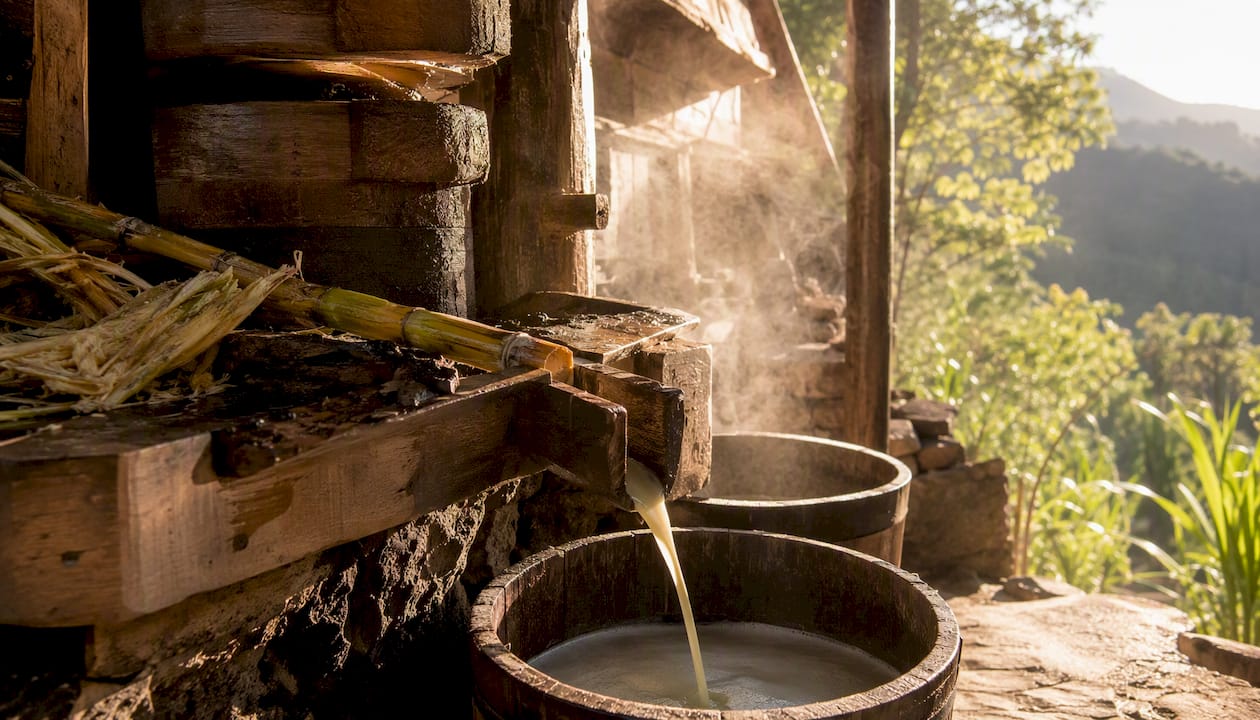
Juice clarification
The raw juice is filtered and heated to remove plant fibers and impurities. Traditional producers use lime (calcium hydroxide) to help clarify; some add natural plant-based flocculants. The clarification method affects the final color and flavor.
Boiling and concentration
The clarified juice is boiled in open pans, often in a series of progressively hotter vessels. As water evaporates, the syrup thickens. The boiling temperature and duration directly influence color, caramelization, and the concentration of phenolic compounds.
Molding or granulation
The thick paste is either poured into molds (producing blocks or cones) or stirred vigorously while cooling to create granules. Granulated forms dry faster and dissolve more easily in recipes; blocks are denser and need grating or dissolving in hot liquid.
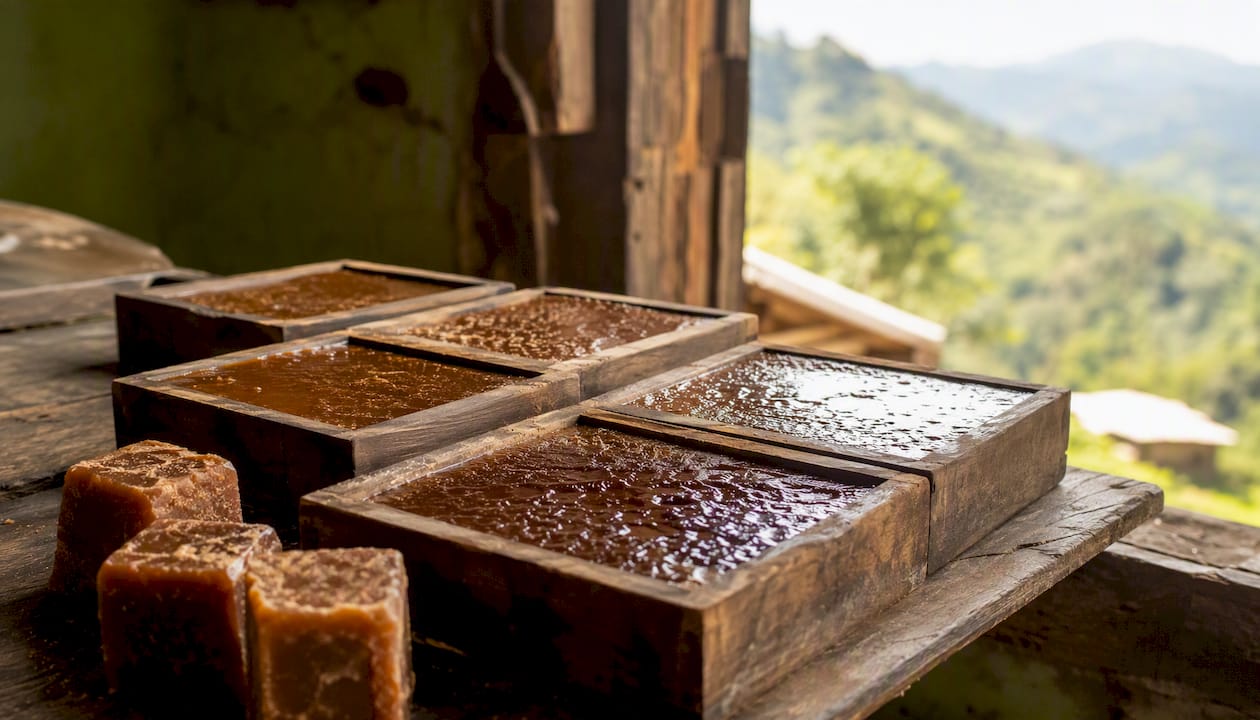
Batch variability is real and expected. Color can range from golden amber to near-black depending on the cane variety, soil, altitude, and boiling time. A darker block is not necessarily better or worse, just different. Small-scale Andean producers working at altitude, for example, often produce panela with a more pronounced caramel note than lowland industrial equivalents.
What’s actually in unrefined cane sugar, and is it healthy?
Unrefined cane sugar contains more trace minerals and phytochemicals than refined sugar, but it is still predominantly sucrose and behaves as an added sugar metabolically. Blood glucose response is essentially the same as white sugar. No major health authority recommends it as a substitute for refined sugar in managing diabetes or metabolic disease.
Typical nutrition profile
The figures below are representative ranges drawn from published research; actual values vary by product and origin.
An MDPI Applied Sciences review confirmed that NCS products show higher total phenolic content and variable mineral levels compared with refined sugar, but the absolute amounts vary widely between batches and origins. The minerals are real. Whether a teaspoon or two per day delivers meaningful dietary benefit is a different question, and the honest answer is: probably not at typical consumption levels.
What the evidence says
A PMC systematic review found antioxidant activity and some anti-inflammatory signals in in vitro and animal models, but concluded that human interventional evidence is insufficient to draw firm clinical conclusions. Lab results and animal studies are promising starting points, not proof of human benefit.
WebMD’s consumer health guidance is direct: for people with diabetes, unrefined cane sugar is still an added sugar that raises blood glucose, and no medical authority recommends substituting it for refined sugar as a treatment for any metabolic condition.
Pragmatic health guidance:
- Treat it as an added sugar and use it sparingly, as the Australian Dietary Guidelines recommend for all added sugars.
- The mineral content is a bonus, not a reason to use more.
- If you have diabetes or a blood glucose condition, consult your GP or an Accredited Practising Dietitian before changing your sugar intake.
- The flavor payoff at small quantities is real; the health payoff at typical cooking quantities is modest at best.
This article provides general nutrition information only and is not a substitute for advice from a qualified health professional.
How to use unrefined cane sugar in cooking
The practical summary: match the sugar to the cuisine and the flavor intensity you want. Muscovado works brilliantly in chocolate cakes, BBQ rubs, and dark marinades. Panela and rapadura suit Latin American drinks, syrups, and baked goods. Jaggery belongs in South Asian curries, chutneys, and sweets. Gula melaka is the go-to for Malaysian desserts like cendol and kuih.
For pairing panela with coffee and other beverages, the caramel and toffee notes in a good Colombian panela complement medium-roast and single-origin coffees in a way that white sugar simply cannot.
Substitution guide
These are practical rules-of-thumb, not laboratory-precise conversions. Unrefined sugars add more moisture and may require small recipe adjustments.
Pro Tip: Always weigh unrefined sugars rather than measuring by volume. Moisture content and granule size vary enough between brands and batches that a cup of muscovado can weigh anywhere from 160 g to 220 g. A kitchen scale removes the guesswork entirely.
Hard blocks of panela or jaggery dissolve fastest when grated on a box grater or broken up and simmered in a small amount of hot water first. If you find small hard pieces in your panela, that is a sign of minimal processing, not a defect. Zestepanela explains this well: those fragments are crystallized sucrose, completely normal in authentic NCS products.
Flavor pairings by type:
- Panela/rapadura: cinnamon, vanilla, cardamom, citrus zest, dark chocolate
- Muscovado: espresso, ginger, allspice, smoked paprika, miso
- Jaggery: tamarind, cumin, coriander, coconut, fennel
- Gula melaka: pandan, coconut milk, lemongrass, rice flour
How to buy unrefined cane sugar in Australia
Health food stores are your most reliable starting point: shops like About Life, Flannerys, and independent organic grocers typically stock at least one NCS product. Some Woolworths and Coles locations carry rapadura or muscovado in the health food aisle, though range varies by store. Online is often the better option for consistent availability, competitive pricing, and access to larger pack sizes.
Labels and certifications to look for
- “Panela,” “rapadura,” “whole cane sugar,” or “non-centrifugal” on the label confirms NCS production.
- Certified organic (Australian Certified Organic / ACO logo, or equivalent) means the cane was grown without synthetic pesticides and the production chain has been audited.
- Fairtrade certified indicates the farming community received a fair price; look for the Fairtrade Australia and New Zealand mark.
- Country of origin stated clearly (Colombia, Brazil, India, etc.) is a positive transparency signal.
Red flags:
- “Raw sugar” or “natural sugar” with no further detail — these terms do not confirm NCS production.
- No origin information at all.
- Suspiciously low price on a product claiming organic and Fairtrade certification simultaneously.
Pack sizes and price expectations
Retail packs in Australia typically run 500 g and 1 kg for home cooks. Bulk options at 5 kg suit avid bakers and small food businesses. Wholesale packs at 25 kg are available for cafés, restaurants, and retailers. Retail pricing for organic panela or rapadura generally sits higher than conventional white sugar, reflecting the labor-intensive production and certification costs. Wholesale pricing per kilogram drops substantially at the 5 kg and 25 kg tiers.
Storage
Store granulated NCS in an airtight container away from moisture and direct sunlight. It keeps well for 12–24 months when stored correctly. Clumping is normal and does not indicate spoilage; break up lumps with a fork or briefly warm the container. Solid blocks last even longer if kept dry and wrapped tightly. Muscovado, being the moistest of the group, benefits most from an airtight seal and a cool pantry.
Disclosure: Zestepanela sells organic panela and is the publisher of this article. The buying guidance above applies to any quality NCS product, not exclusively to Zestepanela’s range.
What does the research actually show?
The honest evidence summary: there is solid laboratory and animal evidence that NCS products contain antioxidant and anti-inflammatory compounds. Human clinical evidence is limited, and no firm clinical conclusions can be drawn yet.
The MDPI Applied Sciences NCS review is the most comprehensive published overview of functional components in NCS. It found higher phenolic and mineral content than refined sugar, documented in vitro and animal evidence for antioxidant and possible metabolic effects, and explicitly flagged wide variability between products and the need for human trials before health claims can be made.
The PMC systematic review on unrefined sugar and inflammation reached a similar conclusion: antioxidant activity is present in lab models, some trials suggest anti-inflammatory potential, but the human interventional evidence base is too thin for clinical recommendations.
Nutritional variability between batches is a practical issue, not just a research caveat. Two products both labeled “organic panela” can differ meaningfully in mineral content, phenolic levels, and moisture depending on cane variety, altitude, soil, and processing. This is why origin transparency and producer accountability matter more than generic label claims.
For cooking decisions, the evidence is sufficient: NCS products deliver genuine flavor complexity that refined sugar cannot replicate, and the trace mineral content is a real if modest bonus. For health decisions, treat it as an added sugar and use it accordingly.
Why high-quality panela is worth choosing
Most of the conversation around unrefined sugar focuses on what it contains. The more interesting question is where it comes from and how it was made.
Industrial NCS production can be as opaque as any commodity supply chain. The flavor complexity and nutritional integrity that make panela worth using depend entirely on the quality of the cane, the care of the boiling process, and the conditions in which the farming community operates. A panela sourced from a single cooperative in the Colombian Andes, produced at altitude using traditional trapiche mills, is a fundamentally different product from a commodity block with no origin story.
Fairtrade certification and direct-trade relationships are not marketing language in this context. They are the mechanism by which small-scale producers can maintain traditional methods without being undercut by industrial volume pricing. When you buy certified organic, Fairtrade panela, you are supporting a supply chain that has economic reasons to preserve the production quality that makes the sugar worth buying in the first place. That alignment of ethics and flavor is not coincidental.
The culinary case is straightforward: panela’s growing presence in Australian cafés reflects what professional cooks have known for years — the depth of flavor at small quantities justifies the price premium over refined alternatives. A teaspoon of good panela in a coffee or a marinade does something white sugar cannot.
Zesté Panela: organic Colombian panela available across Australia
If you want an NCS product you can order today with Australian delivery, Zesté Panela is the publisher’s own recommended option. It is certified organic, sourced from traditional small-scale producers in the Colombian Andes, and produced without centrifugation, so the molasses, minerals, and flavor profile described throughout this article are genuinely present in the product.

Zestepanela ships to all Australian states and territories and offers wholesale accounts for cafés, food businesses, and retailers. The 500 g retail pack is the right starting point for home cooks trying panela for the first time. The 1 kg pack suits regular bakers and coffee drinkers. For cafés and bulk buyers, the 25 kg wholesale option is available directly through the site.
Full disclosure: Zestepanela publishes this article and sells the product recommended above.
Sources
The research summary in this article reflects the best available evidence as of 2026. Human clinical trials on NCS and health outcomes remain limited, and more well-designed studies are needed before firm clinical claims can be made.
- Non-Centrifugal Sugar (NCS) and Health: A Review on Functional Components and Health Benefits — MDPI Applied Sciences
- The Effect of Unrefined Sugar on Inflammation: A Systematic Review of Intervention Studies - PMC
- Is Cane Sugar Refined? Process and Benefits Explained - US Sweeteners
0 comments