

Unrefined sugar is not meaningfully healthier than refined sugar. Both raise blood sugar in similar ways and both count as added sugar, but unrefined varieties like panela carry trace minerals and polyphenols that refining strips out.
- Non-centrifugal sugars retain measurable minerals and antioxidant compounds, while refined sugar is nearly pure sucrose.
- Public health guidance treats all added sugars the same way: limit them, regardless of color or origin.
- Choose unrefined sugar for its flavor and cooking performance, not as a nutrition strategy, and watch your portions either way.
Key Takeaways
Unrefined sugar offers real trace nutrients and better flavor complexity, but it behaves like refined sugar metabolically and should be used the same way: sparingly.
| Point | Details |
|---|---|
| Nutrients are real but small | Unrefined sugars carry trace minerals and polyphenols, but not enough per serving to count as a nutrition source. |
| Blood sugar impact is similar | Both sugar types are simple carbohydrates with comparable glycemic ranges; portion size matters more than sugar type. |
| Flavor is the real reason to choose unrefined | Panela, muscovado, and jaggery add color, moisture, and depth that refined sugar can’t replicate. |
| Check labels, not marketing terms | “Raw” is loosely used; look for single-ingredient sugarcane and clear sourcing instead. |
| Zestepanela offers a transparent unrefined option | Zestepanela’s organic Colombian panela is made by traditional methods that preserve molasses and minerals, and it’s sold in sizes for both home cooks and wholesale buyers. |
Table of Contents
- Unrefined vs Refined Sugar at a Glance
- What Is Unrefined Sugar, and How Is It Made?
- What Is Refined Sugar, and What Does Refining Remove?
- Is Unrefined Sugar Actually Healthier?
- How Do Bakers and Cooks Actually Use These Sugars?
- How to Spot These Sugars on Store Shelves
- What the Evidence Actually Supports
- Where This Guidance Comes From
- Want to Try a Genuinely Unrefined Sugar?
- Frequently Asked Questions
- Sources
Unrefined vs Refined Sugar at a Glance
The fastest way to see the difference is to line up how each sugar is made, what survives processing, and where it belongs in your kitchen.
| Factor | Unrefined sugar (panela, jaggery, muscovado) | Refined sugar (white, caster, powdered) |
|---|---|---|
| Processing | Cane juice evaporated and cooled, minimal or no centrifuging | Multiple purification cycles: centrifuging, filtering, bleaching |
| Nutrient content | Retains molasses, trace calcium, iron, potassium, polyphenols | Nearly pure sucrose; minerals and molasses removed |
| Glycemic impact | Similar glycemic range to refined sugar; small measured differences don’t change practical advice | Rapidly absorbed simple carbohydrate, same general glycemic range |
| Flavor & culinary use | Earthy, caramel, sometimes smoky; adds color and moisture | Neutral sweetness; predictable structure for baking and candy work |
| Common names | Panela, jaggery, muscovado, demerara, turbinado, raw sugar | Granulated, caster, powdered, table sugar, white sugar |
The nutrient column is the one that surprises people. It’s real, but it’s small enough that it should never be the reason you reach for one sugar over another. Flavor is the honest reason.
What Is Unrefined Sugar, and How Is It Made?
Unrefined sugar, technically called non-centrifugal sugar (NCS) by the Food and Agriculture Organization, is made by pressing sugarcane, boiling the juice down, and letting it solidify without spinning off the molasses in a centrifuge. That single missing step is the whole story. Refined sugar spins the molasses away; NCS keeps it.
You’ll see this sugar under a lot of regional names. Panela is the term used across Colombia and much of Latin America. Jaggery covers South Asian versions, often made from cane or palm sap. Kokuto is the Japanese black sugar made through a similar open-kettle process. “Raw sugar” on a US grocery shelf is a looser, less regulated term, and it doesn’t always mean the same thing as true NCS.
Production is low-tech by design: cane is crushed, the juice is filtered, then boiled in open pans until it thickens and is poured into molds or granulated by hand. No industrial centrifuge, no bleaching agents.
What survives that process:
- The molasses fraction, which carries most of the color, aroma, and moisture
- Trace minerals, including calcium, iron, and potassium, though amounts vary by soil and crop
- Polyphenols and flavonoids, the same broad family of compounds found in tea and dark chocolate
- Natural variability. Panela from one region tastes noticeably different from jaggery grown a few hundred miles away
Texture tells you a lot at a glance. Muscovado is soft and sticky. Panela is often sold in hard blocks or granules. Jaggery ranges from a soft paste to a solid brick. Turbinado sits closer to refined sugar with large, dry crystals and a light golden color.
What Is Refined Sugar, and What Does Refining Remove?
Refined sugar is cane or beet sugar put through repeated purification. Raw juice is clarified, filtered, boiled, crystallized, spun in a centrifuge to separate crystals from syrup, then often remelted and refiltered again before it’s dried into the granulated, caster, or powdered sugar on your shelf, according to Ohio State University Extension.
Each cycle strips something away:
- Molasses, which carries most of the color, flavor, and moisture in unrefined sugar
- Minerals like potassium, calcium, and iron that were dissolved in the original cane juice
- Plant pigments and much of the mineral and phenolic content that give unrefined sugar its darker color
- Anything that would make the final crystal inconsistent from batch to batch
That’s not accidental. Refining is built to produce something totally uniform: the same sweetness, the same shelf life, the same behavior in a recipe every single time. It’s why refined sugar dissolves cleanly in tea, holds structure in meringue, and never varies from bag to bag.
The tradeoff is nutritional. Refined sugar isn’t a source of any meaningful nutrient. It’s classified straightforwardly as added sugar, with nothing else going for it beyond sweetness and function.
Is Unrefined Sugar Actually Healthier?
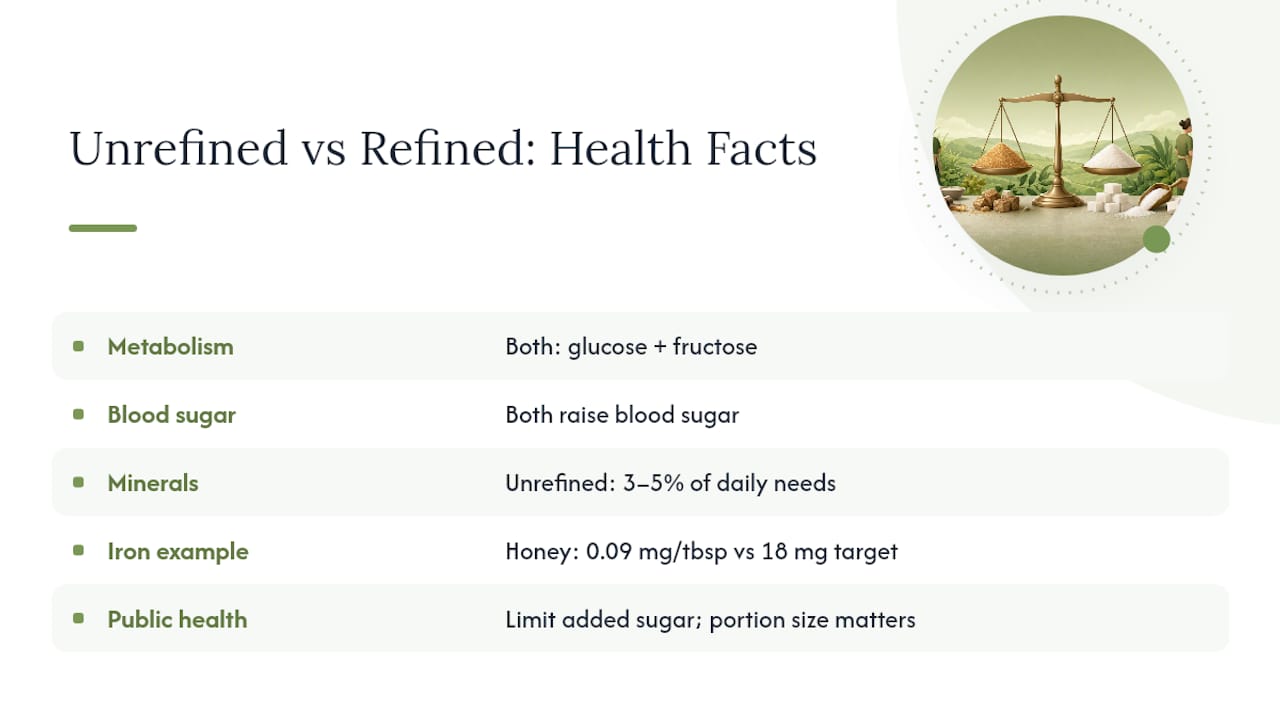
Here’s the metabolic reality up front: both sugars break down into glucose and fructose, and both raise blood sugar. Neither is a “slow carb.” If you’re managing blood sugar or diabetes risk, unrefined sugar doesn’t get you off the hook.
The nutrient argument for unrefined sugar is real but modest. A review of non-centrifugal sugar found measurable minerals, phenolic acids, and flavonoids, with some antioxidant and anti-inflammatory activity in lab and animal studies. That sounds promising until you look at serving size. Honey, a comparable natural sweetener, delivers roughly 0.09 milligrams of iron per tablespoon against an 18-milligram daily target for many adults. You would need to eat an impractical amount of any unrefined sweetener to get a nutritionally relevant dose of anything in it.
Unrefined sugars typically contain 3 to 5 percent of a comparable serving’s worth of daily trace mineral needs, which is a rounding error next to a diet built on vegetables, legumes, and whole grains.
Zoom out and the public health case is consistent: excess added sugar intake, from any source, is tied to higher rates of obesity and cardiovascular disease, and the standing recommendation is to limit added sugar across the board. Glycemic research backs this up on the blood-sugar side too. Measured differences in glycemic index across cane sugars are small, and portion size matters far more than which sugar you picked.
Where does that leave the antioxidant angle? Some smaller trials on sweeteners like maple syrup have shown modest improvements in blood pressure and gut bacteria when swapped for refined sugar, but the effect is small, and researchers are careful to note these are still added sugars eaten in moderation, not health foods.
How Do Bakers and Cooks Actually Use These Sugars?
Pick unrefined sugar when you want flavor, color, or chew. Pick refined sugar when you want neutrality and predictability. That’s the whole decision tree for most recipes.

Straight swaps work more often than people expect. Turbinado subs 1:1 for white sugar as a finishing sugar on muffins or crème brûlée. Muscovado drops into brownies or chewy cookies at a 1:1 ratio and adds a deep, almost toffee-like note. Panela works beautifully in sauces, marinades, and spice rubs, where its smoky sweetness plays against acid and heat.
The catch is moisture. Unrefined sugars hold onto molasses, so they’re naturally wetter than refined sugar.
Pro Tip: When you swap in panela or muscovado for white sugar in a baking recipe, cut the other liquid by a tablespoon or two per cup of sugar, and expect faster, darker browning. Molasses caramelizes early.
Where refined sugar still wins outright: meringues, royal icing, hard candy, and anything relying on pure white color or exact crystallization. Powdered sugar’s fine, dry structure isn’t something jaggery or panela can replicate.
How to Spot These Sugars on Store Shelves
Labels are inconsistent, so knowing the vocabulary helps more than trusting marketing copy. Panela, jaggery, muscovado, demerara, and turbinado are all unrefined or minimally processed. Granulated, caster, powdered, and plain “table sugar” are refined.
- “Raw sugar” is a loose, largely unregulated term. Some raw sugar is genuine NCS; some is just partially refined sugar with molasses added back in.
- “Unrefined” and “non-centrifugal” are more precise claims, but check the ingredient list. It should say one thing: sugarcane, or evaporated cane juice.
- Look for single-ingredient products and, where it matters to you, organic certification and clear sourcing about where and how the sugar was made.
- Small-scale panela production supports rural farming communities and typically uses far less industrial energy than large refineries, which is a real reason some shoppers choose it beyond taste.
What the Evidence Actually Supports
The strongest signal in the research is straightforward: non-centrifugal sugars carry real bioactive compounds, but the human clinical evidence is thin. Most benefit data comes from lab and animal models, not large human trials, and product variability by crop, region, and processing method is significant.
Panela, jaggery, and similar sugars aren’t interchangeable in nutrient content. One region’s panela can differ noticeably from another’s, which is exactly why broad health claims about “unrefined sugar” deserve caution rather than blanket endorsement.
Refining research is more settled. The mechanical steps that turn cane juice into white sugar are well documented, and there’s no serious dispute that refining removes molasses and minerals almost completely.
- Trust the National Geographic review of sweetener research and Ohio State’s extension factsheet for accessible, well-sourced overviews.
- Treat any single-product health claim about “unrefined sugar” skeptically until it names the specific product tested.
- Weigh flavor, culinary function, and sourcing more heavily than nutrition when deciding between the two.
Where This Guidance Comes From
This comparison leans on peer-reviewed reviews of non-centrifugal sugar composition, extension-service processing data, and public-health literature on added sugar, not marketing claims from either side of the sugar aisle.
Zestepanela’s own panela is produced in the Colombian Andes using traditional evaporation methods that keep molasses and minerals intact, and the brand works directly with local farming communities rather than industrial refineries.
Want to Try a Genuinely Unrefined Sugar?
If you’ve read this far, you already know unrefined sugar isn’t a health miracle. It’s a flavor and sourcing upgrade, and that’s exactly what Zestepanela is built around: organic Colombian panela made with traditional evaporation methods that keep the molasses and minerals intact, sourced directly from farming communities rather than industrial mills.

Start with the 500-gram bag if you’re testing panela in sauces, marinades, or baking for the first time. If it earns a permanent spot in your pantry, the 1-kilogram size is the better value for regular cooking, and cafés or bakeries can look at wholesale sizes built for consistent supply. Order a bag and taste the difference for yourself.
Frequently Asked Questions
Is unrefined sugar actually better for you than refined sugar? Not in any meaningful metabolic sense. Unrefined sugar carries trace minerals and polyphenols that refined sugar lacks, but both raise blood sugar similarly and both count as added sugar you should limit.
What’s the difference between refined and unrefined sugar in cooking? Unrefined sugar brings moisture, color, and a caramel or smoky depth that refined sugar can’t match. Refined sugar gives you neutral sweetness and predictable structure, which matters for meringues and candy work.
Is panela healthier than white sugar? Panela retains molasses, minerals, and antioxidant compounds that white sugar loses during refining, but the amounts per serving are too small to change its overall health profile. Use it for flavor, not nutrition.
Can diabetics use unrefined sugar instead of refined sugar? Glycemic differences between unrefined and refined cane sugars are small, so unrefined sugar isn’t a safer option for blood sugar management. Anyone managing diabetes should treat both the same way and consult a healthcare provider about total sugar intake.
How do I know if a sugar is truly unrefined? Check the ingredient list for a single item, usually sugarcane or evaporated cane juice, and look for terms like “non-centrifugal” rather than the looser “raw sugar” label, which doesn’t guarantee minimal processing.
This article is general information, not a substitute for advice from a qualified doctor. Consult a qualified healthcare professional about your own circumstances before acting on anything here.
Sources
- Non-Centrifugal Sugar (NCS) and Health: A Review on Functional Components and Health Benefits
- Why some types of sugar are better than others | National Geographic
- Ncbi
0 comments