

Panela is made by extracting fresh sugarcane juice, clarifying it to remove impurities, evaporating it over open heat until it reaches roughly 88 to 92° Brix, then beating and pouring the concentrated syrup into molds to cool into solid blocks. It’s the same basic process Colombian farms have used for generations at small mills called trapiches, where an experienced worker still judges the exact moment to pour, called the “punto,” by sight and feel rather than a gauge.
TL;DR:
- Proper harvesting is critical; cane must be picked at peak maturity and processed within a day to prevent sugar loss and quality decline.
- Controlling evaporation temperature and timing is essential to avoid overcooking, which increases harmful compounds like acrylamide and HMF.
- Traditional trapiche mills use manual judgment for pouring, preserving flavor and texture, and rely on bagasse as a sustainable fuel source.
- Quality indicators include the color and texture of the final block; overly pale or dark, brittle blocks often signal early or excessive heat exposure.
- Making panela at home is technically possible but difficult to control safely without commercial equipment, making pre-made, traditionally produced options preferable.
Table of Contents
- How Panela Is Made: The Five-Stage Process at a Glance
- Stage 1: Harvesting Cane at the Right Moment
- Stage 2: Milling and Juice Extraction (Molienda)
- Stage 3: Clarifying and Filtering the Raw Juice
- Stage 4: Evaporation, the Stage That Makes or Breaks the Batch
- Stage 5: Beating, Molding, and Cooling Into Blocks
- Quality Control and Food-Safety Checkpoints
- Trapiche Traditions, Bagasse Fuel, and What Standardization Adds
- Why the Details Behind the Process Actually Matter in the Kitchen
- Where to Buy Panela Made the Traditional Way
- Sources
- FAQ
How Panela Is Made: The Five-Stage Process at a Glance
Every batch of panela moves through five stages, and each one shapes the final flavor, texture, and shelf life of the block. Skipping steps or rushing the heat produces a gummy, overly dark, or crumbly product instead of the firm, amber panela found in traditional markets.
- Harvesting and transport: Mature cane is cut and moved to the mill quickly to protect sugar content.
- Milling (molienda): Rollers crush the cane and press out raw juice.
- Clarification: Solids, waxes, and foam are skimmed or filtered out.
- Evaporation: Juice is boiled down from around 20° Brix to a thick “honey,” then to a final concentration above 88° Brix.
- Beating, molding, and cooling: The hot mass is worked, poured, and set into blocks.
Overall yield, the weight of finished panela compared to the weight of cane processed, typically runs between 6.4% and 14.9%, depending on cane variety, mill efficiency, and how well the operation controls evaporation. A backyard trapiche and a semi-mechanized regional mill both follow this same five-stage sequence. What differs is scale and how tightly they control temperature and Brix at each step.
Stage 1: Harvesting Cane at the Right Moment
Cane cut too early carries less sucrose and more water, which drags out evaporation and lowers yield. Most producers harvest by hand with machetes, since selective cutting lets them pick stalks at peak maturity and leave immature cane to keep growing, something mechanized harvesters can’t do as precisely. Cut cane loses sugar quality fast, so mills try to process it within a day of cutting. Leaves, dirt, and rocks that slip in during cutting can clog rollers or dull them, so most operations do a quick manual sort before the cane ever reaches the mill.
Stage 2: Milling and Juice Extraction (Molienda)
The mill, or trapiche, typically runs cane between three or four horizontal rollers that squeeze out the juice under steady pressure. Fresh raw juice usually comes off the rollers at around 17 to 20° Brix, and how much of it gets extracted depends on roller pressure, cane moisture, and how many passes the stalks get. A well-tuned mill can pull most of the available juice; a worn or poorly adjusted one leaves a lot of sugar behind in the crushed stalk. That leftover fiber, called bagasse, isn’t waste. Once it’s dried in the sun for a few days, it becomes the fuel that heats the furnace under the evaporation pans, closing the loop between crop and cooking fire.
Stage 3: Clarifying and Filtering the Raw Juice
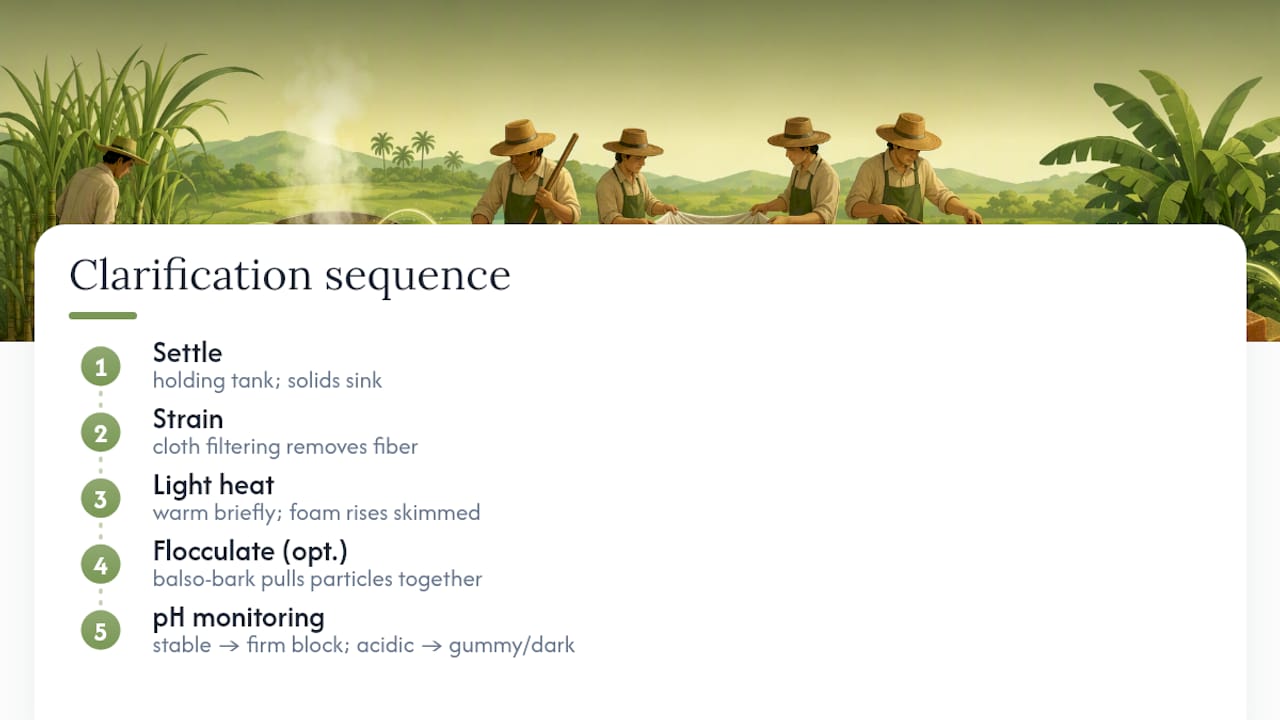
Raw juice is cloudy and full of fine plant fiber, wax, and dirt that needs to come out before boiling starts in earnest. Producers typically let the juice settle briefly in a holding tank, strain it through cloth, and skim the foam that rises once light heat is applied. Some add natural clarifying agents, like ground balso bark or other plant-based flocculants, to pull suspended particles together so they can be skimmed off more easily.
pH control matters just as much as filtering. If the juice turns too acidic during heating, sucrose starts inverting into glucose and fructose, which darkens the final product and interferes with proper crystal formation. Research on panela process characterization recommends monitoring pH through clarification to keep it in a stable range. Skip this step, or rush it, and the panela comes out gummy, overly dark, or prone to melting in storage instead of holding a firm block shape.
Stage 4: Evaporation, the Stage That Makes or Breaks the Batch
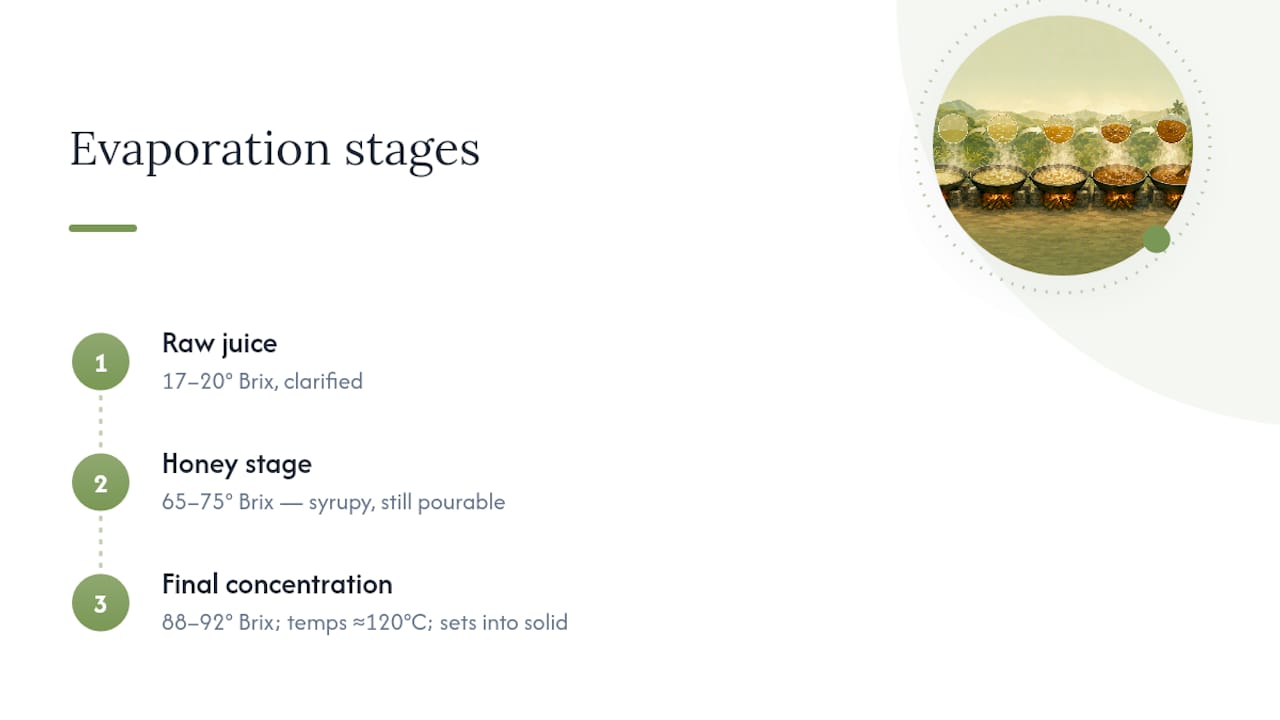
This is where panela actually becomes panela. Clarified juice starts around 17 to 20° Brix and gets ladled through a series of open pans over direct fire, thickening as water boils off. By the midpoint, it reaches an intermediate stage often called “honey,” sitting around 65 to 75° Brix, syrupy but still pourable. The final push concentrates it further, up to roughly 88 to 92° Brix, the range where the mass will actually set into a solid block once it cools.
Process Snapshot: Raw cane juice runs about 17 to 20° Brix. It thickens to 65 to 75° Brix as honey, then concentrates to a final 88 to 92° Brix, the point at which panela is pulled from the fire and worked before it sets.
Temperatures climb sharply in the final minutes, often approaching 120°C as the last of the water cooks off. That short, intense window is also when producers judge the batch is done. Some rely on portable refractometers now, but the traditional test still holds: drop a bit of the syrup into cold water and see if it forms a firm, pliable ball. Producers characterizing panela operations point to visual cues too: color deepening, the syrup pulling away from the pan’s edge, and a change in how it sheets off a stirring paddle.
Overcooking is where things go wrong nutritionally, not just visually. Studies tracking heat-induced compounds in panela found that acrylamide and HMF, both byproducts linked to prolonged high heat, increase sharply during this final concentration stage. That deep caramel color everyone loves comes from the same reaction that produces those compounds, which is exactly why timing the pull from the fire matters as much as hitting the right Brix number.
Stage 5: Beating, Molding, and Cooling Into Blocks
Once the syrup hits its final point, it comes off the heat and gets beaten, usually with a wooden paddle, in a wide cooling trough. Beating does two things: it works air into the mass and disrupts sugar crystals from forming into a hard, grainy lump, which is what gives finished panela its smoother, semi-granular bite instead of a rock-hard texture.
Timing the pour matters. Wait too long and the mass stiffens before it reaches the mold; pour too early and it won’t hold its shape. Traditional molds are wooden or metal, shaped as small cones, rectangular blocks, or round discs depending on the region. Blocks typically cool and firm up within 15 to 30 minutes, after which they’re removed, cooled fully, and wrapped, usually in wax paper or plastic, to keep out moisture. Panela is hygroscopic, meaning it pulls moisture from the air, so tight packaging is what keeps a block firm on the shelf instead of turning sticky within weeks.
Quality Control and Food-Safety Checkpoints
The riskiest windows in panela production aren’t about spoilage in the usual sense. They’re about heat exposure during the final stages of concentration, where two compounds worth watching form:
- HMF (hydroxymethylfurfural): builds up as sugars break down under sustained heat.
- Acrylamide: forms mainly during the final concentration and finishing stages, where sugars and amino compounds react at high temperature.
What the research shows: Acrylamide and HMF levels in panela rise sharply during the concentration and final-product stages, the same window where flavor-building caramelization happens. The formation depends heavily on how long the syrup sits at peak temperature, not just how hot the fire gets.
Reputable producers manage this by shortening time at peak heat rather than avoiding high heat altogether, since some caramelization is what gives panela its character. Smaller batch sizes, better-controlled furnaces, and thorough clarification earlier in the process all reduce the sugar and amino-acid buildup that feeds these reactions. Maintaining the right pH earlier in clarification also helps, since a stable pH slows the side reactions that accelerate compound formation at high temperature.
Trapiche Traditions, Bagasse Fuel, and What Standardization Adds
A trapiche is more than a piece of equipment. Across rural Colombia, it’s often a family operation passed down through generations, where the timing of the pour and the read on when juice is “done” comes from decades of watching a parent or grandparent work the same pans. Colombia remains one of the largest panela producers in the world, and much of that output still comes from these small, family-run mills rather than industrial refineries.
The bagasse loop is part of what makes trapiche production genuinely low-waste: dried cane fiber goes straight back into the furnace as fuel, so the crop that made the juice also cooks it. Some smaller operations have started applying lean manufacturing ideas like Kaizen and 5S, mainly around cleaning schedules and workstation organization. Documented case studies show these changes cut production time and improve consistency without replacing the traditional pans and molds.
Pro Tip: If you’re buying panela and want to gauge quality, check the color and feel before you check the label. A block that’s too pale often means it was pulled early or over-clarified; one that’s overly dark and brittle likely sat too long at peak heat.
Why the Details Behind the Process Actually Matter in the Kitchen
The caramelization that happens in that final evaporation stage isn’t incidental. It’s the entire reason panela tastes like molasses and toffee instead of plain sweet. That’s worth knowing before you swap it into a recipe: because panela dissolves differently than refined sugar, grating it or melting it into warm liquid first works better than dropping a solid chunk into cold batter.
— Nicolas
Where to Buy Panela Made the Traditional Way
Making panela at home is possible in theory, but hitting the right Brix and controlling heat safely at that scale is hard to do consistently without commercial equipment, which is why most home cooks are better served buying it ready-made. Some producers source organic Colombian panela produced with traditional trapiche methods, without shortcuts or centrifugal refining, using cane juice cooked down and molded the traditional way.

A few things worth knowing about what you’re getting:
- Organic, non-GMO sugarcane grown in the Colombian Andes.
- Produced using traditional trapiche methods that retain natural molasses and minerals.
- Sourcing that supports local farming communities.
If you’ve read this far and want to taste the difference clarification and slow evaporation actually make, browse Zestepanela’s panela online and pick a size that fits your kitchen or your pantry.
Sources
- Formation of acrylamide and other heat-induced compounds during panela production (PMC)
- Characterization and improvement of panela production processes (IY C Journal DOI)
- Lean-Kaizen improvements in panela production processes (Tandfonline)
- The panela: a pillar of Colombian rural life — Visit My Colombia
FAQ
Is Panela Better for You Than Refined Sugar?
Panela retains the molasses and trace minerals that refining strips out of white sugar, giving it more nutritional content per gram, though it’s still a concentrated sugar and should be used in moderation.
Is Panela Just Brown Sugar?
No. Brown sugar is refined white sugar with molasses added back in, while panela is unrefined cane juice boiled down as a whole product, with the molasses never separated out in the first place.
How Do They Make Panela?
Producers extract sugarcane juice, clarify it, evaporate it over direct heat to roughly 88 to 92° Brix, then beat and pour the concentrated syrup into molds, where it cools into solid blocks.
Can I Make Panela at Home?
The basic technique, boiling and evaporating cane juice, is simple, but safely controlling the high-heat final stage and hitting the right concentration is difficult without commercial equipment, which is why most home cooks buy panela ready-made instead.
Why Does Panela Have a Caramel-Like Flavor?
The deep flavor comes from caramelization during the final, most intense stage of evaporation, the same heat exposure that concentrates the juice to its finished Brix level.
0 comments