

No, panela is not keto-friendly. A single teaspoon carries about 4 to 5 grams of net carbs, which can represent a significant portion of a strict daily keto carb budget before you’ve touched anything else on your plate.
TL;DR:
- A teaspoon of panela contains about 4.3 grams of net carbs, which can quickly take up most of a strict keto daily carbohydrate allowance.
- Panela’s high sugar content causes rapid blood glucose spikes, insulin release, and halts ketosis, regardless of its mineral or antioxidant benefits.
- One tablespoon of panela exceeds half of a typical 20 to 25 gram keto carb limit, making small amounts nearly impossible to incorporate without risking ketosis.
- Stevia, monk fruit, and erythritol are keto-friendly sweeteners that do not influence insulin or blood sugar responses, unlike panela and other cane sugars.
- While artisanal or organic panela offers flavor and supports small farms, its carbohydrate load remains unchanged and unsuitable for strict keto diets.
Table of Contents
- Panela Nutrition Facts: Carbs, Sugar, and Calories Per Serving
- Why Panela’s Sugar Content Usually Breaks Ketosis
- Portion Math: What a Teaspoon of Panela Actually Costs You
- Low-Carb Sweeteners That Actually Work on Keto
- What Quality Panela Actually Offers, Keto or Not
- Cooking Culture Versus Carb Counting
- Sources
Panela Nutrition Facts: Carbs, Sugar, and Calories Per Serving
Panela is dense in carbohydrates because it’s almost entirely dried sugarcane juice. Databases put it at roughly 85 to 90 grams of total carbohydrate per 100 grams, with about 77 to 78 grams of that coming from natural sugars and calories landing near 350 to 363 per 100 grams. Scale that down to a teaspoon (5 grams) and you get close to 4.3 grams of net carbs, a figure confirmed by food-tracking data on panela sugar servings.
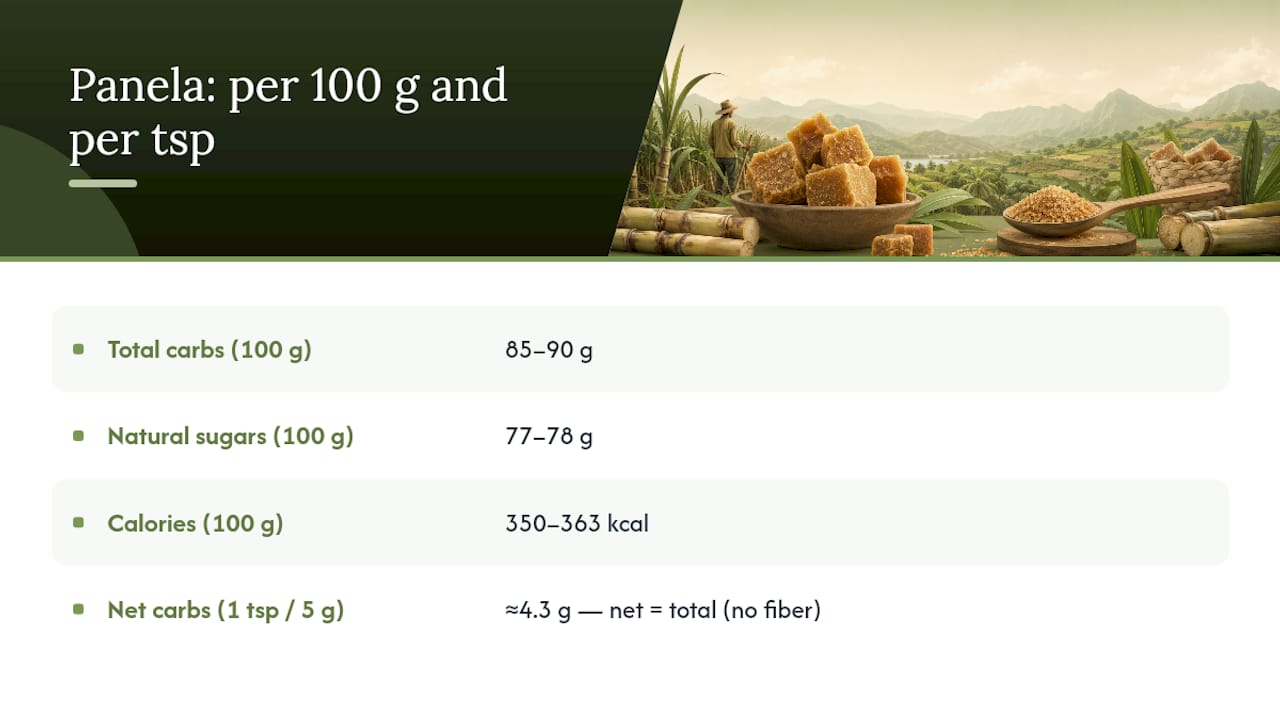
A teaspoon of panela contains close to 4.3 grams of net carbs, roughly the same as a small square of milk chocolate.
Why do numbers shift slightly between sources? Product listings on OpenFoodFacts show carb counts ranging from 89 to 90 grams per 100 grams in some batches, a gap driven by moisture content and how finely the block is ground. Granulated panela tends to read a touch higher per 100 grams than solid blocks simply because it holds less water per gram. For keto tracking purposes, net carbs are the number that matters. Since panela contains essentially no fiber, its net carbs and total carbs are the same number.
Why Panela’s Sugar Content Usually Breaks Ketosis
Ketosis depends on keeping blood sugar and insulin low enough that your liver keeps producing ketones instead of burning glucose. Any concentrated carbohydrate source disrupts that balance, and panela is a concentrated carbohydrate source no matter how it’s marketed.
Here’s the sequence that plays out after you eat it:
- Panela’s sugars digest quickly, mostly as sucrose.
- Blood glucose rises, sometimes fast, because there’s little fiber or fat to slow absorption.
- Insulin releases to manage that glucose spike.
- Elevated insulin signals your body to stop breaking down fat for fuel.
- Ketone production drops, and you exit or stay out of ketosis.
Panela does contain trace minerals, phenolic compounds, and leftover molasses that refined white sugar lacks. A scientific review of non-centrifugal sugar confirms this, describing panela’s minerals and antioxidant content as real but modest, while noting that sucrose remains its dominant component by far. Those bioactive extras don’t cancel out the glycemic impact.
Non-centrifugal sugar retains molasses, minerals, and some phenolic compounds during processing, but sucrose is still the major component of the final product, and its health-supportive compounds don’t offset the sugar load.
Antioxidants are a nice bonus in your diet generally. They are not a keto exemption.
Portion Math: What a Teaspoon of Panela Actually Costs You
Numbers make this easier than physiology. Here’s what different amounts of panela do to a keto carb budget:
- 1 teaspoon (5 g): about 4.3 grams of net carbs, roughly 15 to 20% of a strict 20 to 25 gram daily allowance.
- 1 tablespoon (15 g): roughly 12 to 15 grams of net carbs, over half a tight daily budget in one spoonful.
- 100 grams (a typical cooking portion in a sauce or marinade): 85 to 90 grams of net carbs, more than double most keto daily limits in a single dish.
One tablespoon of panela can consume more than half of a typical 20 to 30 gram keto daily carb allowance.
There’s no clean version of “a little bit is fine” here. A quarter teaspoon stirred into coffee might add only 1 to 2 grams, which some people on a looser, liberal low-carb approach could absorb without falling out of ketosis. On strict keto, though, that’s still carbs you didn’t need, and they add up fast across a day of coffee, sauces, and dressings. If you’re tracking carbs to the gram, panela is one of the easiest ways to blow the budget without realizing it.
Low-Carb Sweeteners That Actually Work on Keto
You don’t have to give up sweetness, just the sugarcane. Three sweeteners consistently show up in keto kitchens for good reason:
- Stevia delivers intense sweetness at zero carbs, though the liquid form blends into drinks more smoothly than the powder does in baking.
- Monk fruit has a cleaner aftertaste than stevia for most people and works well in both drinks and desserts.
- Erythritol behaves closest to real sugar in baking, adding bulk and browning that stevia and monk fruit alone can’t replicate.
Australian keto guidance points to stevia and monk fruit as the preferred picks for maintaining ketosis, specifically because they don’t spike insulin the way cane-based sugars do. Many keto bakers blend erythritol with monk fruit for a better texture and flavor match than either delivers solo.
If you’re chasing panela’s specific caramel, almost-smoky depth rather than just sweetness, a small amount of blackstrap molasses stirred into an erythritol or monk fruit blend gets you closer than either sweetener alone. Use it sparingly and count the carbs from the molasses itself, since it isn’t carb-free.
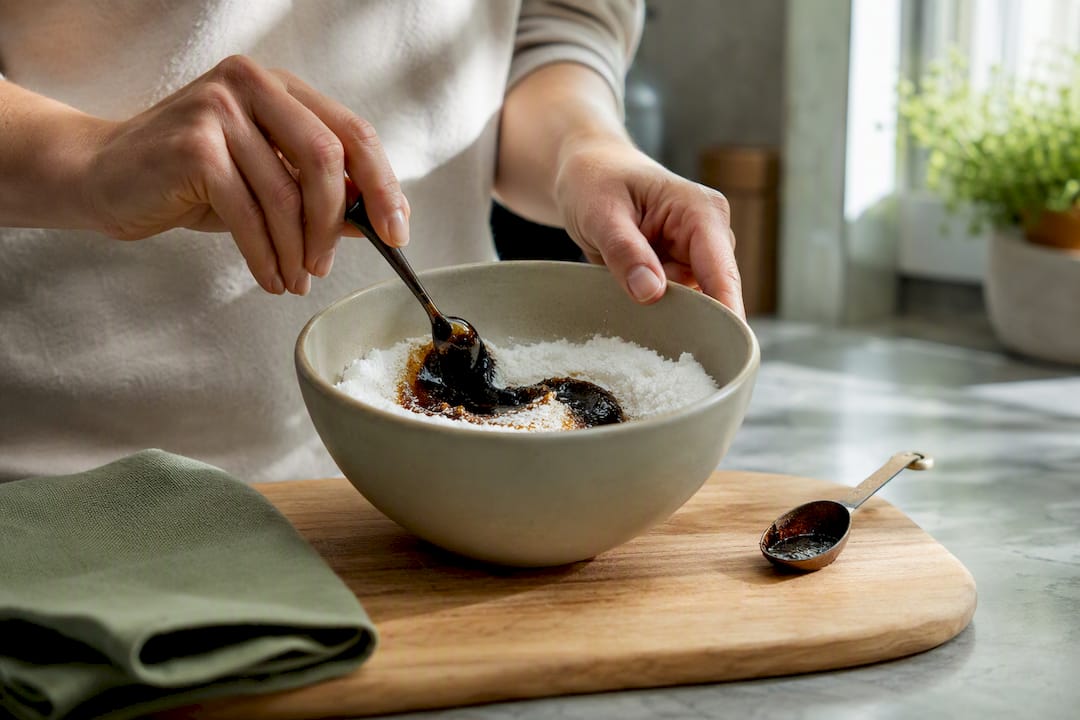
Pro Tip: Start with a 3 to 1 ratio of erythritol to monk fruit blend, then add molasses extract or a few drops of real blackstrap molasses a quarter teaspoon at a time until the flavor reads as “panela” instead of “generic sweetener.”
Sugar alcohols like erythritol don’t affect everyone the same way. Some people notice bloating or a laxative effect at higher amounts, so introduce it gradually and watch how your digestion responds before committing to it as your daily sweetener.
What Quality Panela Actually Offers, Keto or Not
Panela’s appeal has nothing to do with keto compatibility and everything to do with how it’s made. A producer offers organic, unrefined panela using traditional Colombian methods that preserve molasses and minerals stripped out of refined white sugar.
That provenance matters for flavor and for supporting small farming communities. It doesn’t change the carb math above.
- Trace minerals and artisanal processing don’t lower the sugar content or the insulin response.
- Panela still works well for non-keto baking days, marinades, or occasional treats.
- If you use it outside a strict keto plan, portion control still matters given how carb dense it is.
Cooking Culture Versus Carb Counting
Panela has a real place in Latin American cooking, in coffee, in desserts, in savory glazes where its molasses depth does something refined sugar simply can’t. I understand the pull toward it.
None of that changes the verdict. If ketosis is the goal, panela stays in the pantry for non-keto days, and stevia, monk fruit, or erythritol take its place at the table. If blood sugar management alongside occasional panela use is more your situation than strict ketosis, the guidance on panela and diabetes is worth a closer read before you decide how it fits your plate.
— Nicolas
Sources
Nutrition figures in this article draw from MyFoodData’s panela entry, Carb Manager’s serving data, and the MDPI review of non-centrifugal sugar. For provenance details, visit Zestepanela.
- Health effects of non-centrifugal sugar (NCS) — review (MDPI)
- Nutrition Facts for Panela - 100% Dehydrated Cane Juice
- Carbs in Ceres Organics Panela Sugar
- Keto sweeteners in Australia — MealPrep
0 comments