

Colombian panela is unrefined whole cane sugar, made by boiling sugarcane juice down into a solid block without spinning off the molasses or minerals. The technique traveled from South Asia to Iberia and then to the Americas after 1493, taking root in what is now Colombia within decades of Spanish colonization. Panela became a daily staple, a rural livelihood, and a piece of national identity that has outlasted refined sugar’s dominance in global markets.
TL;DR:
- Over 350,000 Colombian families and tens of thousands of trapiches produce between 1.2 and 1.5 million tonnes of panela annually, mainly from smallholder farms.
- Traditional trapiche production relies on skilled judgment rather than machinery, with key steps including hand harvesting, boiling, and molding, often through seasonal community efforts.
- Panela retains more minerals and antioxidants than refined sugar, but it still primarily consists of sucrose and should be consumed in moderation.
- Industrial refining and ethanol markets threaten small trapiches by offering more predictable and higher returns, leading to niche strategies like fair pricing and heritage tourism for survival.
- Panela has evolved from a rural staple to a premium, artisanal product exported globally, with regional variants like piloncillo, rapadura, and chancaca sharing core processing methods.
Table of Contents
- The Origins of Colombian Panela History
- How Traditional Trapiches Make Panela
- Panela’s Role in Colombian Households and Rural Economies
- A Timeline of Panela and Its Regional Names
- Does Panela’s Nutrition Match the Health Claims?
- Modern Pressures Facing Colombia’s Trapiches
- What Zestepanela Knows About Working With Panela
- Panela’s Place in Colombia’s Colonial and Post-Colonial Economy
- Indigenous and Afro-Colombian Communities in Panela’s History
- The Trade and Export History of Colombian Panela
- How Panela Consumption Has Changed Over Generations
- Why Panela’s Story Still Matters Today
- Sources
- FAQ
The Origins of Colombian Panela History
Cane-juice concentration is not a Colombian invention. Farmers in India were boiling sugarcane juice into solid, unrefined blocks (known there as jaggery) more than a thousand years before Europeans encountered the crop. That knowledge moved west along trade routes into the Middle East, then into Iberia, where Spanish and Portuguese growers adapted it for their own cane fields.
The real turning point for Colombian panela history came after 1493, when sugarcane crossed the Atlantic as part of the Columbian Exchange, first to the Canary Islands, then to the Caribbean, then onto the South American mainland. Spanish colonists introduced cane cultivation to Colombia in the 16th century, and the milling technique localized fast in the fertile valleys of the Andes.
- Ancient South Asian jaggery-making techniques provided the technical foundation.
- Sugarcane arrived in the Caribbean and mainland Colombia through Spanish colonization after 1493.
- Early production centers formed in regions like Cundinamarca and Santander, where cane thrived at mid-altitude.
Within a few generations, panela wasn’t an imported curiosity. It was a homegrown industry running on local labor and local land.
How Traditional Trapiches Make Panela
A trapiche is a small rural sugar mill, and it’s where panela production still happens the way it did centuries ago. Workers cut cane by hand, feed it through rollers to press out the juice, then move that juice through a sequence of open boiling pans over wood fires until it thickens into a dense syrup.
- Harvest and crush. Cane is cut at peak ripeness and crushed within hours, since the juice ferments quickly once exposed to air.
- Boil and clarify. The juice passes through several pans, each hotter than the last, while impurities are skimmed off the surface.
- Concentrate. As water evaporates, the liquid thickens from a thin syrup into a dark, viscous paste.
- Mold and cool. Workers pour the paste into wooden or metal molds, where it hardens into blocks, discs, or cones as it cools.
The whole cycle runs on timing more than machinery, and a skilled panelero judges readiness by texture and color rather than a thermometer. That knowledge gets passed down, not written down, which is part of why the process has changed so little. Trapiches also double as low-tech, labor-intensive community hubs, often running seasonally around harvest windows that pull in extended family and neighbors for the boiling shifts.
Pro Tip: If you’re cooking with panela at home, grate or chop it before adding it to a hot liquid. Whole blocks dissolve unevenly and can leave gritty pockets at the bottom of a pot.
Panela’s Role in Colombian Households and Rural Economies
Panela shows up in Colombian kitchens more often than most Western sweeteners show up in American ones. Dissolved in hot water, it becomes aguapanela, a drink served at breakfast, offered to guests, and given to children and laborers as a quick source of energy. It sweetens coffee, flavors desserts like cocadas, and rounds out savory sauces in regional dishes.
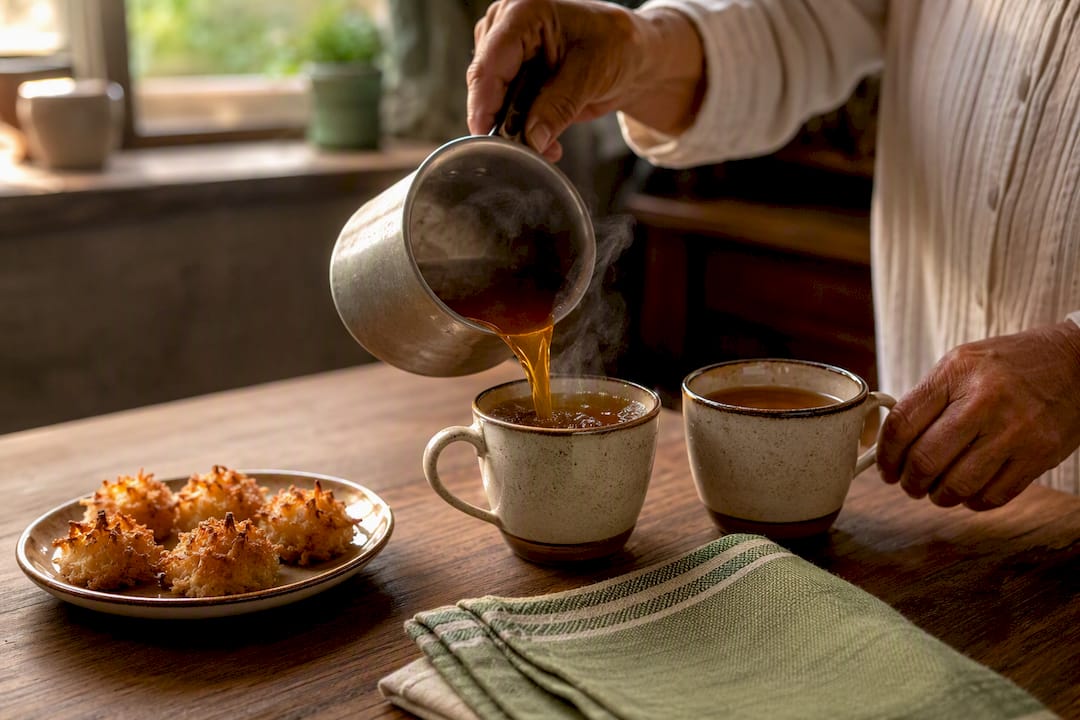
That everyday role has deep economic roots. Panela historically served as a transportable calorie source for field workers and travelers, and in some rural markets it functioned almost like an informal currency, tradeable for other goods when cash was scarce.
By the numbers: Panela production involves roughly 350,000 Colombian families and tens of thousands of trapiches spread across more than 164 municipalities, with national output estimated between 1.2 and 1.5 million tonnes a year.
- Smallholder farms, not industrial plantations, supply most of the cane.
- Trapiches often employ extended family networks during harvest season.
- Panela ranks among Colombia’s most widely produced agricultural goods by volume.
A Timeline of Panela and Its Regional Names
Panela’s spread across Latin America produced a family of related sweeteners, each shaped by local taste and terrain.
- 16th century: Sugarcane and boiling techniques arrive in Colombia through Spanish colonization.
- 19th century: Panela becomes entrenched as a rural staple and cash crop across Andean smallholdings.
- 20th century: Industrial refined sugar competes for market share, but trapiches persist in rural regions.
- 21st century: Panela gains recognition abroad as an unrefined, mineral-retaining alternative to white sugar.
Mexico calls a similar product piloncillo, Brazil calls its version rapadura, and parts of Central America use chancaca. All three share the same core process: boiling cane juice without centrifuging out the molasses. The differences lie in shape, hardness, and how each culture cooks with them, which matters if you’re following a recipe that assumes one texture over another.
Does Panela’s Nutrition Match the Health Claims?
Panela is not a health food in the way marketing sometimes implies, but it isn’t nutritionally identical to refined white sugar either. A 100-gram serving of panela typically contains around 79 milligrams of calcium, 81 milligrams of magnesium, and 12 milligrams of iron, minerals that refining strips out of white sugar almost entirely. Sucrose still makes up the bulk of the product.
A scientific review of non-centrifugal sugars found measurable polyphenols and antioxidant compounds with potential functional effects, but concluded that clinical benefits remain limited and that composition varies widely between producers and regions.
That’s the honest summary from the research on non-centrifugal sugar and health: panela carries more nutritional residue than refined sugar, but it’s still sugar. Moderation applies here the same way it applies to any sweetener, and the retained minerals and molasses are a bonus, not a license for unlimited use.
Modern Pressures Facing Colombia’s Trapiches
Small trapiches compete against two forces that didn’t exist a century ago: industrial refined sugar mills and the ethanol market, both of which can offer more predictable returns for cane growers who switch supply. That pressure puts smallholder panela producers at a structural disadvantage, since ethanol demand and industrial refineries can outbid traditional buyers for raw cane.
The response has leaned toward niche positioning rather than scale. Fair pricing arrangements, value-added products, and heritage tourism built around trapiche visits all give small producers a way to compete without racing refineries on volume.
- Ethanol and industrial sugar markets draw cane away from traditional panela production.
- Rural trapiches risk closure without steady demand or fair pricing.
- Festivals, tourism, and export-quality niche products help sustain smallholder income.
What Zestepanela Knows About Working With Panela
Buying panela is one thing. Cooking and storing it well is another, and that’s where a lot of home cooks run into trouble.
- Store panela in an airtight container away from humidity. It absorbs moisture readily, and tracking moisture content is the difference between a block that grates cleanly and one that turns rock-hard or sticky.
- Grate or chop panela before dissolving it in hot liquid for aguapanela, sauces, or baking.
- To make a syrup, dissolve chopped panela in a small amount of hot water over low heat, then use it as a 1:1 substitute for simple syrup in drinks and desserts.
- Panela’s molasses content makes it a strong swap for brown sugar in baking, with a deeper, less one-note sweetness.
Zestepanela sources organic, non-GMO panela made through traditional methods, and works directly with Colombian farming communities to keep that production model economically viable.
Panela’s Place in Colombia’s Colonial and Post-Colonial Economy
Panela entered the colonial economy as a byproduct of Spain’s broader sugar ambitions, but it quickly became something distinct from the plantation-scale white sugar destined for export to Europe. While large estates grew cane for refined sugar and rum, smaller landholders and rural communities across the Andean highlands developed panela as a local, self-sufficient product that didn’t depend on colonial trade routes to have value.
That distinction mattered after independence. When Colombia’s colonial-era trade structures broke down through the 19th century, panela production kept functioning because it never depended on a single export market or a centralized supply chain. Each region ran its own trapiches, sold locally, and answered to local demand rather than a distant colonial administration. This decentralization gave panela an economic resilience that plantation sugar never had.
Panela also became entangled with land tenure patterns that persisted long after independence. Smallholders who couldn’t compete for prime lowland cane acreage found a niche in higher-altitude terrain suited to panela cane varieties, carving out an agricultural economy parallel to, rather than dependent on, the large estates. That pattern of small-scale, geographically dispersed production is still visible today in the more than 164 municipalities where panela is made.
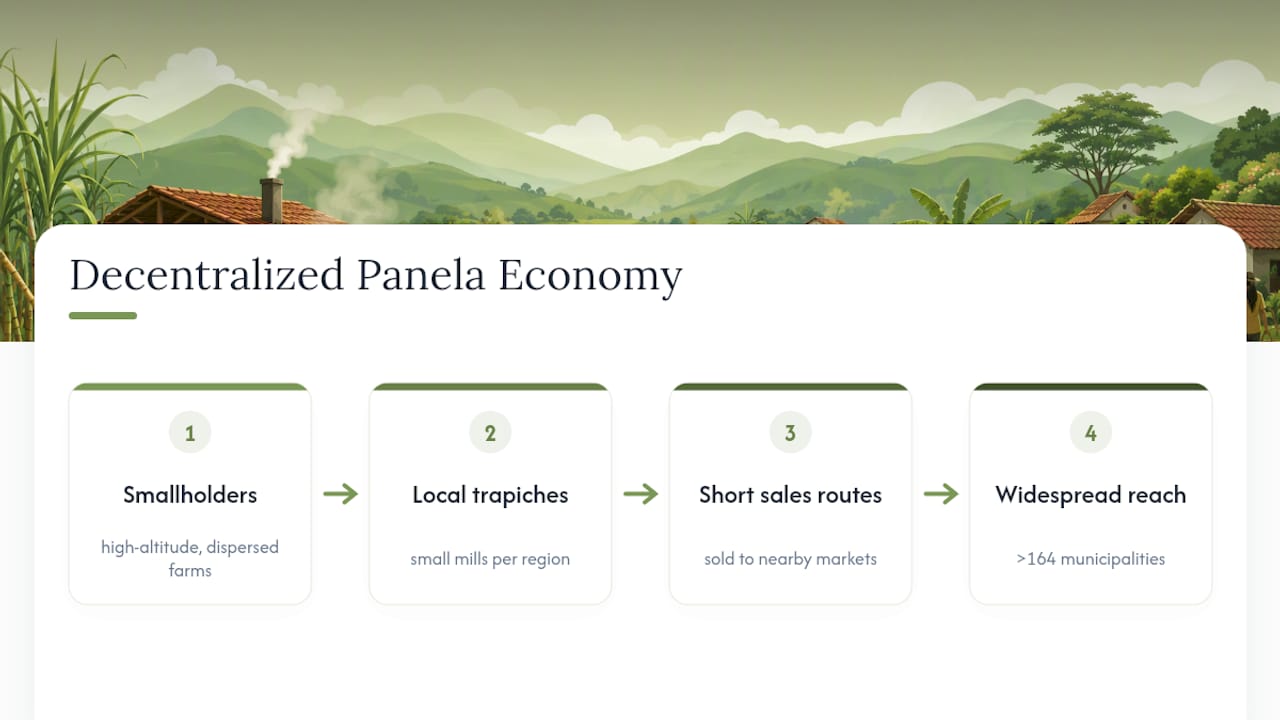
By the 20th century, panela had become one of the clearest examples of a colonial-era crop that evolved into a genuinely national, rural economic institution rather than an export commodity controlled by outside interests.
Indigenous and Afro-Colombian Communities in Panela’s History
Panela production didn’t emerge in a vacuum. It grew on top of agricultural knowledge and labor systems that predated and ran alongside Spanish colonization, and indigenous and Afro-Colombian communities shaped that history in ways that don’t always make it into the standard telling.
Indigenous communities in the Andean highlands already had deep knowledge of cultivating and processing crops at altitude before cane arrived, and that agronomic expertise adapted readily to sugarcane once it was introduced. Many of the regions that became panela strongholds, including parts of Cundinamarca, Santander, and Boyacá, sit on land indigenous farmers had worked for generations before colonization.
Afro-Colombian communities, many descended from people brought to Colombia through the transatlantic slave trade to work sugar estates, brought their own labor and technical knowledge to cane processing. Enslaved and later freed Afro-Colombian laborers worked both the large sugar plantations oriented toward export and the smaller trapiches that fed local and regional panela markets. In some regions, particularly the Cauca Valley, Afro-Colombian communities became central to sugarcane cultivation long after abolition in 1851, carrying forward processing techniques that blended African, indigenous, and Iberian influences.
That layered labor history means panela isn’t a single-origin story. It’s a product shaped by at least three cultural streams working the same land under very different circumstances, and its survival as a smallholder crop owes something to all of them.
The Trade and Export History of Colombian Panela
For most of its history, panela was a domestic product, not an export commodity. Refined white sugar, not panela, was Colombia’s cash crop for international trade during the colonial and early republican periods, since refined sugar traveled and stored better and matched European taste preferences.
That began shifting only in recent decades. Rising global interest in unrefined, minimally processed sweeteners opened export channels that didn’t exist a generation ago. Panela started reaching markets in the United States, Europe, and increasingly Australia, where it’s found a foothold in specialty cafés and restaurants looking for an alternative to refined sugar and syrups.
Export volumes remain small next to Colombia’s domestic consumption, and that’s by design as much as by limitation. Most panela is still produced by smallholders and trapiches without the scale or certification infrastructure to ship internationally at volume. The producers who do export tend to focus on organic certification and traceability, positioning panela as a premium ingredient rather than a bulk commodity competing on price with refined sugar.
That positioning has arguably helped preserve traditional production methods. Because export-grade panela commands a premium tied to its artisanal origins, there’s less commercial pressure to industrialize the process purely to compete on cost, unlike commodity sugar markets where mechanization is the only way to survive.
How Panela Consumption Has Changed Over Generations
Panela consumption in Colombia has followed a slow arc from universal daily staple toward a more selective, identity-driven choice, though it never disappeared the way some traditional foods do when industrial alternatives arrive.
Through the 19th and much of the 20th century, panela was the default sweetener for most Colombian households, particularly in rural areas, because it was locally produced, affordable, and calorically dense for laborers doing physical work. Refined white sugar was often the more expensive, urban, or aspirational option.
That relationship inverted somewhat in the mid to late 20th century as refined sugar became cheaper and more widely distributed, and as urbanization pulled people away from the rural trapiche communities where panela production was concentrated. For a stretch, refined sugar carried the modern, urban connotation, while panela read as rustic and old-fashioned to younger, city-dwelling Colombians.
The trend has bent back again more recently. Renewed interest in traditional foods, plus growing awareness of panela’s retained minerals and lower processing footprint compared with refined sugar, has repositioned it as a deliberate, even premium, choice rather than a rural default. Aguapanela remains a household constant, but panela now also shows up in specialty coffee shops, craft cocktails, and baking recipes aimed at people actively choosing an unrefined sweetener rather than simply inheriting one.
Why Panela’s Story Still Matters Today
Trapiches survive because families keep choosing to run them, not because the economics make it easy. Supporting panela made through fair, traditional methods, and treating it as a flavorful ingredient rather than a health cure, is how that history stays alive instead of becoming a museum piece. If you’re building it into your own kitchen, consider Zestepanela’s organic panela a starting point worth exploring, sourced from producers keeping this craft going.
— Nicolas
This article is general information, not a substitute for advice from a qualified doctor. Consult a qualified healthcare professional about your own circumstances before acting on anything here.
Sources
For deeper background on the topics covered here, consult the Wikipedia entry on panela for definitions and regional naming, the non-centrifugal sugar health review for nutrition evidence, and the Serious Eats feature on trapiche production for a firsthand look at the milling process.
- Panela — Wikipedia
- Non-Centrifugal Sugar (NCS) and Health: A Review on Functional Components and Health Benefits — MDPI / PMC
- How panela is made — Serious Eats
FAQ
What Is Colombian Panela?
Colombian panela is unrefined whole cane sugar made by boiling and evaporating sugarcane juice until it hardens into a solid block, retaining the molasses and minerals that refining removes.
Is Rapadura Healthier Than Refined Sugar?
Rapadura and panela retain minerals like calcium, magnesium, and iron along with some polyphenols, but both remain mostly sucrose, so any nutritional edge over refined sugar is modest and calls for moderation, not unlimited use.
Is Panela Just Brown Sugar?
No. Brown sugar is typically refined white sugar with molasses added back in, while panela is never refined in the first place, so it keeps its original mineral content and a denser, more caramel-like flavor.
Where Did Sugar Come From During the Columbian Exchange?
Sugarcane and cane-processing techniques that originated in South Asia traveled through Iberia and crossed the Atlantic after 1493, first reaching the Canary Islands and Caribbean before spreading to mainland Colombia during Spanish colonization.
Why Do Small Trapiches Still Exist Alongside Industrial Sugar?
Trapiches survive because panela production remains decentralized, family-run, and tied to local and export markets that value traditional methods, though competition from ethanol and industrial refineries continues to pressure smallholder producers.
0 comments