

Yes, panela works as an excellent sourdough flavoring when you use it in modest amounts.
TL;DR:
- Using more than 20 grams of panela per 500 grams of flour can slow fermentation significantly, especially beyond 15% baker’s percentage.
- Add panela at the final dough stage and dissolve it in warm water beforehand to prevent grit and ensure it incorporates smoothly.
- For best baking results, lower oven temperature or tent with foil if panela causes early browning due to its faster caramelization.
- Granulated or grated panela are preferred for control over sweetness and color, while block panela requires pre-grating or melting.
- Keep your starter on a basic flour-and-water routine; do not feed it with panela to maintain predictable fermentation behavior.
Table of Contents
- What Panela Is and How Each Form Behaves in Dough
- How Much Panela Should You Use for a 500g Flour Loaf?
- When Should You Add Panela: Starter or Final Dough?
- How Does Panela Affect Fermentation, and How Do You Fix Problems?
- How Do You Mix Panela Into Dough Without Grit?
- How Should You Adjust Baking Temperature for Panela Dough?
- Why Zesté Panela Works Well for Sourdough Baking
- A Baker’s Honest Take on Experimenting With Panela
- Where to Buy Panela for Your Next Sourdough Bake
- Sources
- FAQ
What Panela Is and How Each Form Behaves in Dough
Panela is unrefined whole cane sugar, boiled down and hardened without the refining steps that strip away molasses. That’s what gives it a caramel, almost smoky depth that white sugar can’t touch, and it’s the same family as rapadura and piloncillo. It shows up in three practical forms, and each one changes how you’ll work it into dough.
- Block panela delivers the richest flavor but needs grating, chopping, or a quick melt before it goes anywhere near your dough.
- Granulated panela (sometimes labeled rapadura) is the easiest option for home bakers. It measures like sugar and dissolves fast.
- Panela syrup dissolves almost instantly and adds a small amount of moisture, which matters if your dough is already on the wetter side.
For most sourdough applications, granulated or finely grated panela is the better choice. It gives you control over exactly how much sweetness and color you’re introducing, without the guesswork of melting a block on the stove.
How Much Panela Should You Use for a 500g Flour Loaf?
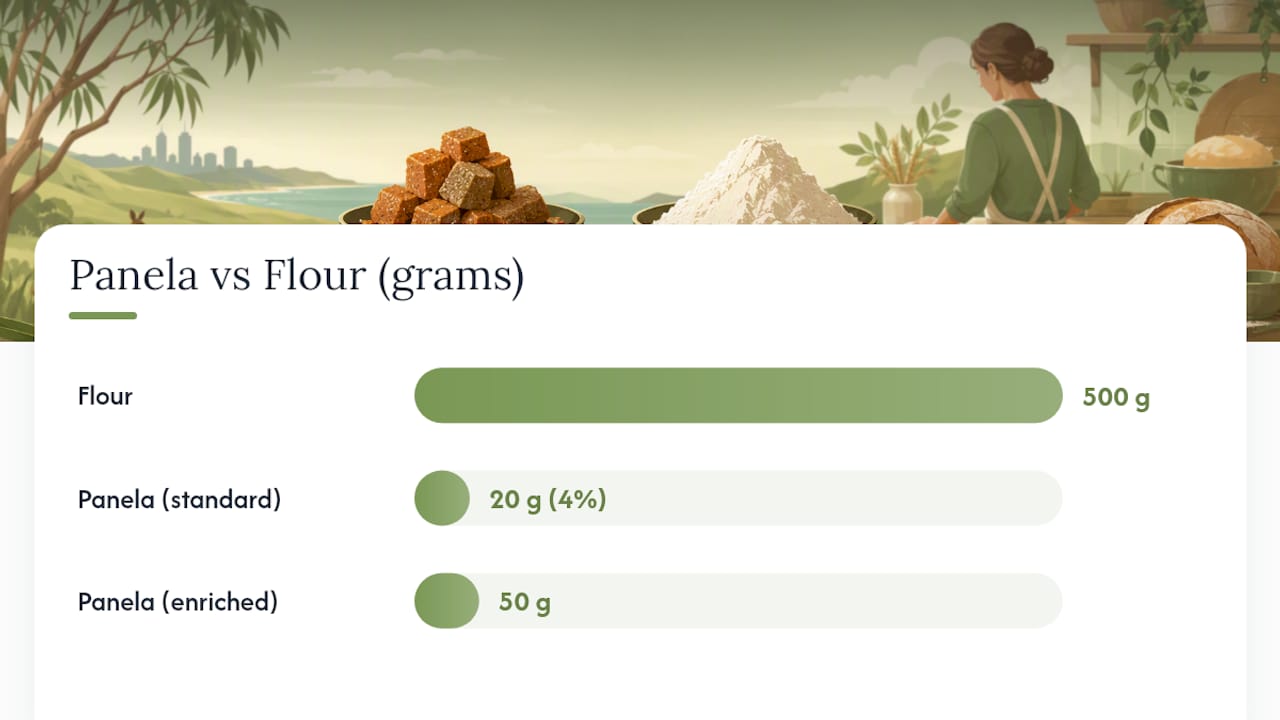
Enriched doughs like sweet buns or brioche-style sourdough can push closer to 50 grams without major issues, since those recipes are already built around slower, richer fermentation.
Baker’s percentage means every ingredient is expressed as a percentage of the total flour weight. Flour is always 100%. So if your recipe calls for 500 grams of flour and you want a 4% panela addition, the math is simple:
- Multiply flour weight by your target percentage: 500 x 0.04 = 20 grams of panela.
- Weigh the panela on a kitchen scale rather than eyeballing it. Small errors compound fast at these low percentages.
- Adjust your total liquid slightly if you’re dissolving the panela into part of your water, so your hydration percentage stays accurate.
Pro Tip: *Weigh panela to the gram, not the teaspoon.
At that range, sugar starts pulling water away from yeast and bacteria through osmotic pressure, and The Sourdough Baker’s guidance on sugar notes that fermentation can slow noticeably. There’s no reason to go anywhere near that range for a standard loaf.
When Should You Add Panela: Starter or Final Dough?
Keep your starter on a plain flour-and-water routine. Feeding it panela introduces a variable that makes your starter’s behavior harder to predict, and a 50g sugar test on starter activity shows how quickly added sugar throws off the rise you’re used to tracking. Your starter is the one part of this whole process that should stay boring and reliable.
Panela belongs in the final dough, not the starter. Here’s how that plays out in practice:
- Add it at the mix stage, right alongside your flour and water, so it has the whole bulk fermentation to integrate.
- If you’re doing stretch-and-folds, you can also work dissolved panela in during an early fold if you forgot it at mix time.
- For a sweeter, more enriched loaf, build a staged preferment and keep a small reserve of your regular starter untouched, so you always have a known baseline to fall back on.
- A simple workflow: weigh your panela, dissolve it in a portion of your recipe’s water, then mix that sweetened water into the dough right after autolyse.
This keeps your starter’s fermentation timeline intact while letting you control flavor and color independently.
How Does Panela Affect Fermentation, and How Do You Fix Problems?
Sugar and salt both work through osmotic stress. Beyond 15%, that slowdown can become severe enough to stall fermentation almost entirely, according to The Sourdough Baker.
You’ll usually notice the effects before you need to check a scale. Watch for:
- A bulk rise that takes noticeably longer than your usual timeline.
- A denser, tighter crumb than you’d expect from your normal hydration.
- Crust that starts browning earlier in the bake than usual, thanks to the sugar caramelizing faster.
If you spot any of these, you have four easy levers to pull. Extend your bulk fermentation time to compensate for the slower activity. Increase your starter percentage slightly to add more active culture to the mix. Or drop your oven’s finishing temperature a touch to keep the crust from racing ahead of the crumb.
None of this means panela is risky to use. It just means it’s an ingredient that asks for the same attention you’d give hydration or salt. Dr. Kate Howell at the University of Melbourne frames sourdough flavor as the product of yeast, bacteria, and environment working together, and added sugar is simply one more variable you’re choosing to control, not a shortcut to fix a sluggish starter.
How Do You Mix Panela Into Dough Without Grit?
Grainy pockets of undissolved panela are the most common complaint from bakers trying this for the first time, and it’s an easy problem to avoid. Follow these steps:
- If you’re starting with a block, grate it on the coarse side of a box grater, or soften it with a 10 to 20 second microwave trick first so it grates cleanly instead of crumbling into uneven chunks.
- Dissolve your measured panela into a portion of your recipe’s mixing water, ideally warm water, and let it cool to lukewarm before it touches your dough. Hot water can damage the yeast culture in your starter.
- Skip the microwave-melt approach if you’re only working with a small amount. Melting is really only worth the trouble for larger batches or when you’re making panela syrup for a different use.
Large, unmelted chunks do two things you don’t want: they tear at the gluten structure as the dough is worked, and any piece that ends up near the crust surface will scorch before the interior finishes baking. Dissolving solves both problems at once, and it’s genuinely the technique most home bakers skip until their second attempt.
How Should You Adjust Baking Temperature for Panela Dough?
Panela caramelizes faster than white sugar, so your crust will darken earlier in the bake than you’re used to. Watch the top of the loaf in the last third of baking, and if it’s browning ahead of schedule, tent it loosely with foil or drop your oven’s finishing temperature by 10 to 15 degrees.
A preheated, lidded Dutch oven remains the most forgiving setup for home bakers, as explained in this traditional Yucatecan cochinita pibil recipe that uses steam-retention cooking techniques very similar to baking with a Dutch oven. It traps steam during the critical first stretch of the bake, which keeps the crust flexible while the crumb finishes rising. The Wholefood Collective’s sourdough recipe preheats at 250°C, bakes covered, then finishes uncovered, and that structure works well as a starting point for panela dough too. A baking stone or steel with a steam pan is a reasonable alternative if you don’t own a Dutch oven.
- Preheat your vessel at 250°C for at least 30 minutes before baking.
- Bake covered for the first 20 minutes to lock in steam and oven spring.
- Remove the lid and finish uncovered, watching closely for early browning from the panela’s sugar content.
Every oven runs a little differently, so treat these numbers as a launch point and adjust based on what you see through the oven door.
Why Zesté Panela Works Well for Sourdough Baking
This panela is an organic, unrefined whole cane sugar with molasses notes that make panela worth using in the first place, preserved through its traditional production and supply chain. That traceability matters more than it sounds. A lot of “panela” on grocery shelves has been processed enough to lose the depth that separates it from plain brown sugar.
For sourdough specifically, a few internal resources are worth bookmarking as you experiment:
- How to dissolve panela fast, for the exact method covered above.
- A 1:1 panela conversion guide if you’re adapting a recipe originally written for white or brown sugar.
- The starter sugar test, if you’re curious what happens when sugar does end up in a starter feeding.
Raw sugars like panela also pair naturally with warming spices. Serious Eats notes that cinnamon, orange zest, and vanilla all complement the molasses notes well, which is worth keeping in mind if you’re building toward an enriched, spiced sourdough loaf down the line.
A Baker’s Honest Take on Experimenting With Panela
Start conservative. Write down your dough temperature, your bulk fermentation time, and your final loaf weight for both. Leave your starter’s feeding routine exactly as it was. The instinct to tinker with everything at once is understandable, but it’s also how bakers end up blaming panela for a problem that was actually a warm kitchen or an underfed starter.
— Nicolas
Where to Buy Panela for Your Next Sourdough Bake
This panela is sourced from Colombian growers, preserving its molasses and mineral content in a way that mass-processed brown sugar can’t match. For sourdough experiments specifically, that traceability is the whole point: you’re adjusting one variable, and you want to know that variable is consistent every time you weigh it out.

If you’re testing panela in sourdough for the first time, start with a smaller retail pack so you can run a few control-loaf comparisons before committing to anything larger. Once you’ve settled on a percentage and process that works for your kitchen, a larger pack makes more sense for regular baking. Browse the full Zesté Panela and Zesté Matcha collection to pick the size that fits how often you bake.
Sources
- The science behind sourdough — University of Melbourne
- Sugar + Sourdough — The Sourdough Baker
- Perfect fluffy sourdough bread — The Wholefood Collective
- What Is Panela Sugar? — Martha Stewart
FAQ
What Type of Pan Is Best for Baking Sourdough Bread?
A preheated, lidded Dutch oven gives the most consistent results for home bakers because it traps steam during the early bake and helps the crust stay flexible while the loaf springs up. A baking stone or steel paired with a steam pan is a solid alternative if you don’t have a Dutch oven, as covered in The Wholefood Collective’s recipe.
What Ingredients Should I Avoid in Sourdough?
There’s no strict ban list, but ingredients that introduce a lot of fat, salt, or sugar all at once can interfere with fermentation if added carelessly. Panela falls into that category above roughly 10 to 15% baker’s percentage, where osmotic stress starts slowing yeast and bacterial activity noticeably.
What Is the 1/3/3 Rule for Sourdough Starter?
There’s no single agreed-upon “1/3/3 rule” in sourdough baking, and definitions vary depending on where you encounter the term. Some bakers use it loosely to describe a starter feeding ratio, but the safer approach is to stick with a consistent flour-and-water feeding schedule that keeps your starter’s rise predictable.
What Is the Best Flour for Sourdough?
A strong bread flour with solid gluten content generally produces the most reliable sourdough structure, especially once you’re adding extras like panela that can slow fermentation slightly. Whichever flour you choose, keeping it consistent across your test loaves matters more than the specific brand, since that’s what lets you isolate panela’s effect on rise and flavor.
Can Zestepanela’s Panela Be Used Directly in Sourdough Recipes?
Current pack sizes and pricing are available on the Zesté Panela collection page.
0 comments