

Panela in Australia typically runs from about $3 for a small 250g bar up to $24 for a premium organic 1kg block, which works out to roughly $12 to $24 per kilogram depending on pack size and certification. You’ll find it online through specialty grocers, marketplaces, and direct-brand stores, with shipping available to every state. If you want a traceable, Colombian-sourced option you can order today, Zesté Panela sells it in multiple pack sizes with Australian distribution already built in.
TL;DR:
- Smaller packs like 250 grams can cost up to $36 per kilogram, while 1kg packages often offer better value at around $14 to $24 per kilogram.
- Organic-certified panela adds a premium, often pushing prices toward $20 per kilogram, especially with direct Colombian sourcing confirming origin and traceability.
- Buying from wholesale distributors or in bulk (2kg or more) usually reduces the per-kilogram cost, but shipping fees and storage conditions impact overall value.
- Prices vary significantly between vendors, with specialty grocers charging more than direct brands, and marketplace listings showing wide price spreads for similar pack sizes.
- Zesté Panela provides Australian-distributed, directly sourced Colombian panela, suitable for home cooks, cafes, and small wholesale buyers, with transparent pricing and traceability.
Table of Contents
- How Much Does Panela Cost Per Kilogram in Australia?
- Where Can You Buy Panela in Australia?
- What Makes Panela More or Less Expensive?
- How Do You Compare Two Panela Offers Fairly?
- Why Zesté Panela Is a Solid Pick for Australian Buyers
- How I’d Buy Panela If I Were Stocking My Own Kitchen
- Ready to Buy Panela Direct From the Source?
- Sources
- FAQ
How Much Does Panela Cost Per Kilogram in Australia?
Pack size drives the price more than almost anything else, and once you convert everything to a per-kilogram figure, the differences between brands get a lot easier to see.
A 250g pack usually sits between $3 and $9, which sounds cheap until you do the math: that’s $12 to $36 per kilogram once you account for smaller packaging and handling costs. A 500g pack, the most common size on Australian shelves, ranges from roughly $6 to $24 depending on whether it’s organic-certified and where it was packed. A 1kg block tends to offer the best value, often landing between $14 and $24, or $14 to $24 per kilogram.
Here’s a worked example. Say you find a 500g bag priced at $12. Divide that by 0.5 (kilograms), and you get $24 per kilogram. Compare that to a 1kg pack at $18, which works out to $18 per kilogram, and suddenly the bigger pack is the better deal even though the sticker price looks higher.
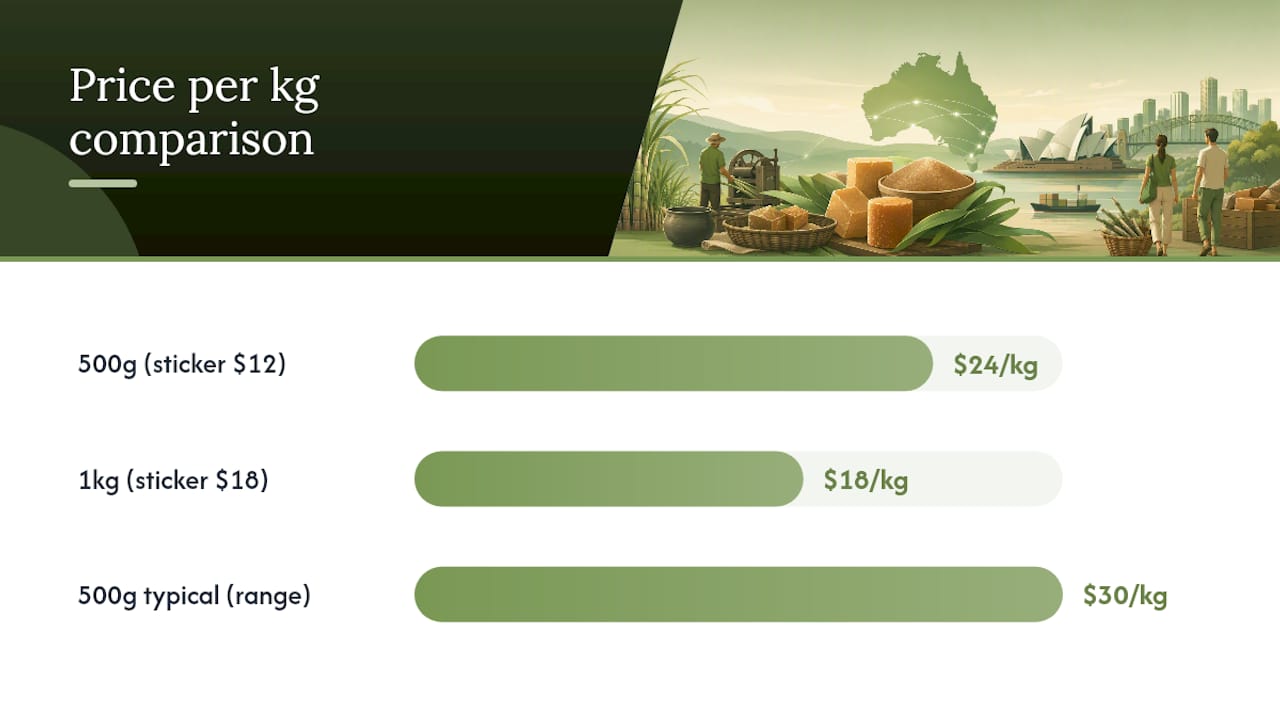
Pro Tip: Always convert to $/kg before comparing two listings. A “cheaper” small pack can quietly cost more per kilogram than a bulk option sitting right next to it.
A few things push the price up or down:
- Organic certification adds a noticeable premium, often pushing the average toward the $20/kg mark rather than the $14/kg you’d pay for uncertified panela.
- Marketplace listings on sites like Amazon Australia show wide price spreads for near-identical pack sizes, so the same 500g bar can vary by several dollars between sellers.
- Specialty grocers usually charge more per kilogram than direct-brand stores because they add their own retail margin on top of the import cost.
Where Can You Buy Panela in Australia?
You’ve got four realistic channels, and each one trades convenience for price differently.
Buying direct from a brand’s own online store, like Zesté Panela’s product collection, usually gets you the freshest stock and the clearest traceability back to the producer. Specialty online grocers stock panela alongside other whole-food sweeteners, which is handy if you’re already shopping there for other items, though their per-kilogram price tends to run higher. Marketplaces such as Amazon offer the widest selection and fastest price comparison, but quality and freshness vary a lot between sellers. Wholesale distributors serve cafés and retailers with 1kg and multi-kilogram packaging at a lower unit cost, sometimes with free delivery once you cross a minimum order value.
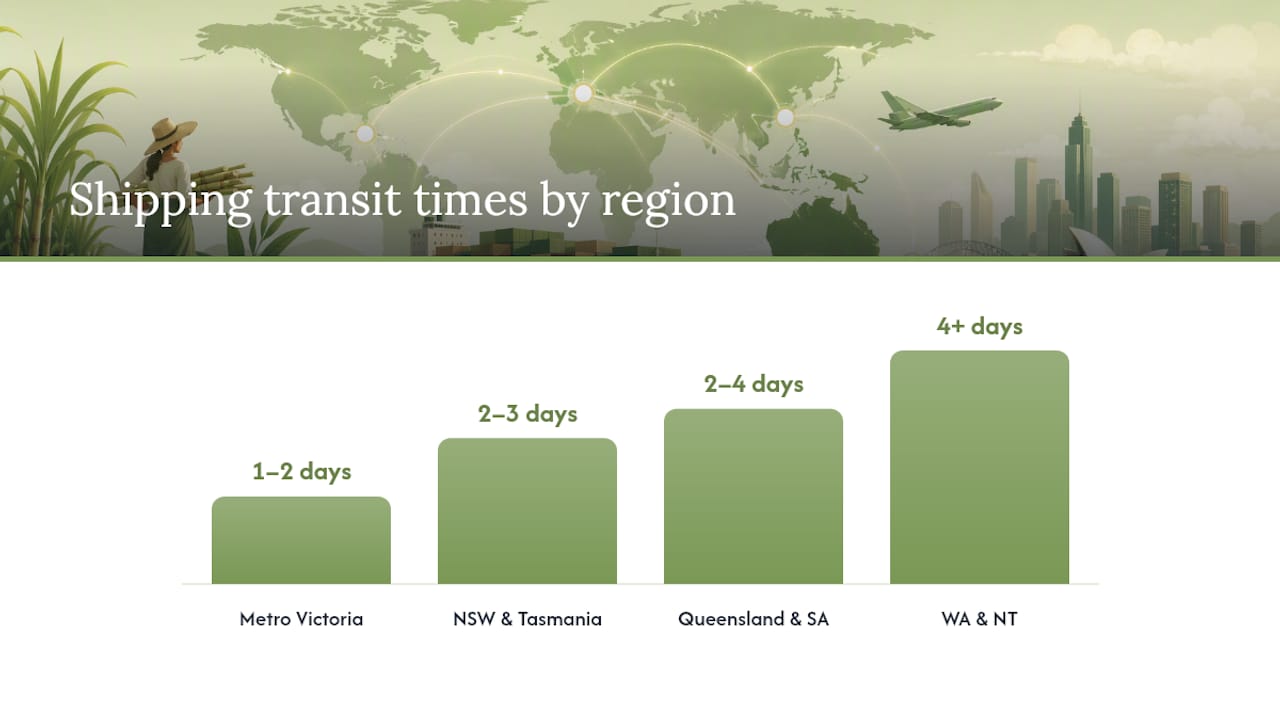
Shipping timing depends heavily on where you live. Domestic transit guidance puts metro Victoria at 1 to 2 business days, New South Wales and Tasmania at 2 to 3 days, Queensland and South Australia at 2 to 4 days, and Western Australia or the Northern Territory at 4 or more days. That gap matters more than people expect, especially for time-sensitive café orders.
- If you’re a home cook buying for occasional baking, retail packs of 250g to 500g cover you without tying up cash in stock you don’t need yet.
- If you can store 1 to 5 kilograms without worrying about moisture or pests, buying in bulk almost always beats the per-kilogram cost of repeated small orders.
- Watch for free-shipping thresholds. A $10 shipping fee on a $15 order effectively adds $20/kg to a 500g pack, which erases any bargain you thought you found.
What Makes Panela More or Less Expensive?
Five factors explain almost every price difference you’ll see between listings.
- Origin and traceability. Panela sourced directly from Colombian producers, where the sugar cane is grown and processed using traditional methods, often carries a premium because buyers are paying for a documented supply chain rather than an anonymous bulk import.
- Organic certification. Certified organic panela costs more to produce and audit, and that cost gets passed straight through to the shelf price.
- Packaging and pack size. Smaller packs cost more per kilogram because packaging, labeling, and handling are fixed costs spread across less product.
- Import and freight costs. Getting an unrefined whole cane sugar from South America to Australian shelves involves ocean freight, customs, and domestic distribution, all of which show up in the final price.
- Retailer overhead. Specialty stores that repackage bulk panela into smaller retail units add storage and labor costs that bulk wholesalers skip entirely.
How Do You Compare Two Panela Offers Fairly?
Before you buy, run through a short checklist:
- Confirm the exact pack size and calculate $/kg yourself, don’t trust the sticker price alone.
- Check the shipping cost and whether it’s free above a certain order value.
- Look for an organic claim and whether it’s actually certified, not just implied.
- Ask about origin and traceability, ideally down to the country or region.
- Check the best-before date, since panela sitting in a warehouse for a year loses aroma.
- Read the return policy in case the product arrives damaged or stale.
Here’s how that plays out. Offer A: a 500g pack for $10 with $8 flat shipping. Landed cost is $18 for 500g, or $36/kg. Offer B: a 1kg pack for $20 with free shipping over $30, so you add a second item to hit the threshold. Landed cost per kilogram drops closer to $20/kg once shipping is spread out.
- Ask the seller directly: what country did this panela come from, and can you name the producer?
- Ask if there’s a bulk discount past 2kg or 5kg.
- Ask how old the current batch is.
Why Zesté Panela Is a Solid Pick for Australian Buyers
Zesté Panela sources directly from Colombian producers using traditional production methods that preserve the natural molasses and minerals refined sugar strips away. That direct relationship supports the farming communities growing the cane, and it means the panela reaching Australian buyers hasn’t passed through several unnamed middlemen before it lands in your pantry.
The brand handles packaging and distribution within Australia, which keeps the supply chain traceable from farm to your kitchen, illustrating the benefits of local sourcing in specialty food supply. It suits home cooks who want an unrefined alternative to processed sugar, as well as cafés and small wholesale buyers who need consistent flavor for coffee and baking.
- Pack sizes available for both individual buyers and bulk orders
- Direct import model without unnecessary distributor markups
- Suited to home baking, specialty coffee, and small-batch café use
How I’d Buy Panela If I Were Stocking My Own Kitchen
Retail convenience wins when you’re testing a new sweetener or only bake occasionally. But once panela becomes a regular part of your kitchen, wholesale-style 1kg packs almost always save money over repeated 250g purchases.
Keep it sealed and away from humidity. Panela absorbs moisture fast, and that changes its texture. For flavor value, use it where its molasses content actually shows, like a pour-over coffee or a caramel-forward baked good, rather than somewhere a plain sweetener would do the same job for less.
— Nicolas
Ready to Buy Panela Direct From the Source?
Zesté Panela is the more direct option compared to grocery aisles stacked with panela of unclear origin. Every pack ships from Australian distribution after being imported straight from Colombian producers, which means no unnamed intermediaries marking up the price between farm and your pantry.

The full collection includes the 500g pack for everyday cooking and the 1kg block for households or small cafés that go through panela regularly. Buying the larger size lowers your landed $/kg, especially once you factor in that a single shipment covers weeks of use instead of a handful of bakes. If you run a café or retail shop and want to talk wholesale volumes and dedicated shipping terms, reach out through the collection page to start that conversation. Whichever size you pick, add the shipping cost into your per-kilogram math before you compare it against anything else on the shelf.
Sources
FAQ
How much is a tonne of sugar cane worth?
Sugar cane pricing is set by industry contracts and fluctuates with global commodity markets, so there’s no single fixed figure that applies everywhere. Panela pricing at the retail level in Australia depends far more on processing, packaging, and import costs than on raw cane value alone.
Is panela just brown sugar?
No. Panela is an unrefined whole cane sugar made by evaporating fresh sugar cane juice, which keeps the natural molasses and minerals intact. Brown sugar is usually refined white sugar with molasses added back in afterward, so the two have different production processes and flavor profiles.
Is panela sugar bad for you?
Panela is still a sugar, so it affects blood glucose similarly to other sweeteners and should be used in moderation. Because it retains molasses and minerals through its unrefined production process, some people prefer it to heavily processed white sugar, though it isn’t a low-sugar or health-food substitute.
What are current sugar prices in Australia?
Standard refined white sugar is typically cheaper per kilogram than panela, often costing a few dollars per kilogram in supermarkets. Panela costs more because of its import origin, unrefined processing, and smaller-scale production, with typical retail prices for panela ranging from about $12 to $24 per kilogram depending on pack size and certification.
Does Zesté Panela ship to all Australian states?
Yes, Zesté Panela distributes across Australia, with transit times varying by state much like general domestic shipping guidance suggests, faster to metro Victoria and New South Wales, slightly longer to Western Australia and the Northern Territory. Check the product pages directly for current pack sizes and pricing.
0 comments