

Yes, panela is normally halal. It’s a single-ingredient product made by boiling and evaporating raw sugarcane juice, with no animal-derived inputs and none of the bone-char refining steps that raise questions about some white sugars. Buy Zesté Panela or any other packaged panela, and you should still confirm the ingredient list reads “100% dehydrated sugarcane juice” and check for a halal mark if one matters to you.
TL;DR:
- Panela is generally halal because it contains only dehydrated sugarcane juice without animal-derived additives or refining steps involving bone char.
- Confirming halal status requires checking for a certification mark or verifying that the ingredient list is solely sugarcane juice and the product does not contain additives or flavorings.
- Shared packing lines or imported packaging without transparent origin details can introduce contamination risks, so certification and source transparency are important.
- Products labeled as piloncillo, rapadura, chancaca, or jaggery are typically equivalent to panela but require label review for additives or processing details.
- Buying from reputable brands like Zesté Panela, which sources organic Colombian panela from traditional non-refinable methods, ensures higher confidence in halal compliance.
Table of Contents
- What Panela Is and How It’s Made
- Is Panela Halal? The Core Reasoning and Authoritative Bases
- When Panela Might Not Be Halal: Processing and Contamination Risks
- How to Verify a Panela Product Is Halal: A Practical Checklist
- Why Trust Zesté Panela: Provenance, Production, and Proof Points
- A Halal-Conscious Buyer’s Perspective: Shopping and Cooking Tips
- Where to Buy Zesté Panela and How to Get More Product Details
- Primary Sources to Verify Claims
- Sources
What Panela Is and How It’s Made
Panela starts as sugarcane, and nothing else gets added along the way in its traditional form. Farmers crush the stalks to extract raw juice, then boil it down in open pans until the water evaporates and what’s left is a thick, dark syrup. That syrup gets poured into molds and left to harden into blocks, cones, or discs. No centrifuge spins out the molasses, no chemical whitening agents strip the color, and nothing derived from animals enters the process at any stage, according to the production history documented on Wikipedia.
This matters for the halal conversation because the entire ingredient statement, in most traditional panela, is one line: sugarcane juice, concentrated and dried. That’s a very different profile from refined white sugar, which goes through additional processing that historically has used bone char as a filtering agent in some countries. Panela skips that step entirely because it skips refining altogether.
You’ll see this same product under different names depending on where you’re shopping:
- Piloncillo in Mexico, usually sold as small cones
- Rapadura in Brazil and parts of the Caribbean
- Chancaca in Peru and Chile
- Jaggery in South Asia, which is a close cousin made from cane or palm sap
Jaggery and panela sit in the same family. Both are non-centrifugal sugars that retain natural molasses, and both are typically permissible for the same ingredient-based reasons. The naming confusion is worth knowing about, because a shopper searching for “is panela halal” might walk past a product labeled “rapadura” or “piloncillo” without realizing it’s the same thing. Reading the ingredient panel, not just the front label, resolves that fast.
Is Panela Halal? The Core Reasoning and Authoritative Bases
Two things determine whether a sugar product is halal: what’s in it, and how it got made. Panela clears both bars in its standard form.
On ingredients, pure panela contains exactly one thing: concentrated sugarcane juice. There’s no gelatin, no animal-derived glazing agent, no alcohol-based flavoring, nothing that would trigger a halal red flag. When a product’s ingredient list shows 100% sugarcane derivation with nothing else on it, the ingredient side of the evaluation is about as simple as it gets for a food product.
On processing, panela’s advantage comes from what it doesn’t do. Refined white sugar sometimes passes through a decolorizing step using bone char, a filtering material made from animal bones, in certain production regions. This has made refined sugar a genuine point of concern for some halal-conscious buyers. Panela never enters that pipeline. Because it’s a non-centrifugal, unrefined product, it retains its natural molasses and skips the refining stages where bone char shows up. That single structural fact removes the most common halal objection to sugar products before it even applies.
Panela’s halal status: a traditional block of panela has a single ingredient, no refining stages, and no animal-derived processing aids, contrasting with white sugar’s multi-stage refining process that can involve carbon or bone-char filtration depending on the producer and country.
So how do certifiers actually confirm this instead of leaving it to guesswork? Halal certification bodies don’t just check what’s printed on the ingredient label. They audit the facility, trace the supply chain, and confirm that shared equipment, packing lines, and storage aren’t cross-contaminating a product with non-halal material. In Australia, halal certification practice specifically covers this combination of ingredient sourcing and processing conditions, which is exactly why a certification mark carries more weight than a self-declared “no animal products” claim on packaging.
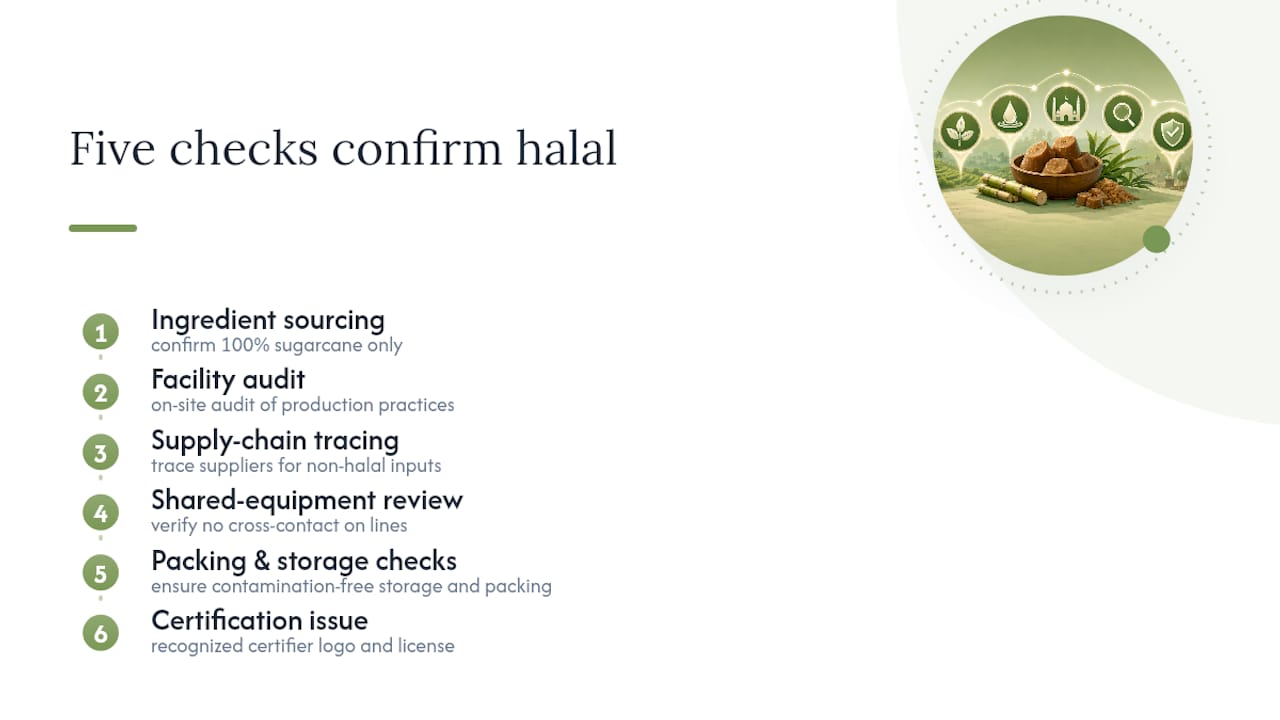
Here’s the caveat that matters more than anything else in this section: a halal certification mark is the definitive answer. Everything else, including the ingredient-and-process reasoning above, is strong circumstantial evidence but not a guarantee for every single product on every shelf. If you’re holding a bag of panela with a recognized certifier’s logo and license number printed on it, you’re done. If you’re not, use the checklist further down to close the gap yourself.
When Panela Might Not Be Halal: Processing and Contamination Risks
Plain panela is about as low-risk as sweeteners get, but “plain” is the operative word. A few real-world scenarios can move a specific packaged product from “almost certainly fine” to “worth double-checking.”
- Added flavors or anti-caking agents. Some commercial panela, especially flavored or granulated versions sold for convenience, includes additives to prevent clumping or to add cinnamon, vanilla, or other flavoring. Those additives occasionally use alcohol-based carriers or animal-derived glazing agents, which pure block panela never needs.
- Shared packing lines. A facility that processes panela alongside products containing alcohol or animal-derived ingredients introduces a cross-contamination risk that has nothing to do with the panela itself and everything to do with equipment sanitation between runs.
- Fermentation and rum-making. Panela is a traditional base ingredient in some Latin American rum and fermented-beverage production. Using panela as a raw material for rum-making doesn’t make the sugar itself non-halal, but it’s a reminder that panela’s flexibility as an ingredient means its downstream use varies, and a product marketed toward that use case is a different animal entirely from a block you’d stir into tea.
- Opaque imported labeling. Panela imported in bulk or repackaged under a private label sometimes strips out the detail a shopper needs. If the country of origin, the producer, and the processing method aren’t stated anywhere, you’re relying on trust rather than verification.
This is also why a handful of community-run halal food resources flag certain packaged panela products as uncertain rather than confirmed when the label doesn’t give enough to go on. That’s not a knock on panela as a category. It’s a reflection of inconsistent labeling across brands.
Pro Tip: If a panela product lists more than one ingredient, that’s your cue to slow down and read the rest of the label carefully. Pure panela has exactly one line on the ingredient panel. Anything longer means something else got added, and you’ll want to know what before it goes in your pantry.
How to Verify a Panela Product Is Halal: A Practical Checklist
You don’t need a food science degree to run this check. It takes about two minutes per product, and most of it happens before you ever add anything to your cart.
- Read the ingredient statement first. Look for a single line: sugarcane juice, or “100% dehydrated sugarcane juice.” One ingredient means one thing to verify.
- Look for a halal certification mark. A logo with a certifier name and license or certificate number on the packaging is the strongest signal available, since it means an accredited body has already audited the facility.
- Contact the manufacturer if there’s no certification. Ask two direct questions: do they use shared packing lines with alcohol-containing or animal-derived products, and can they confirm no animal-derived additives are used anywhere in production. A supplier with nothing to hide will answer both without hesitation.
- Check for origin transparency. A brand that names its country of origin and, ideally, the specific producer or region gives you a traceable supply chain instead of a black box.
- When in doubt, default to certified. For everyday cooking at home, ingredient-based reasoning usually gets you there. For gifts, communal meals, or anything served to guests, a certified product removes the guesswork entirely.
| What to check | Where to find it | What it tells you |
|---|---|---|
| Ingredient list | Back of package | Confirms single-ingredient sugarcane product with no additives |
| Halal certification mark | Front or back of package | Confirms facility and process audited by a certifying body |
| Country/producer of origin | Package or brand website | Confirms traceability of supply chain |
| Manufacturer contact response | Direct inquiry (email or phone) | Confirms shared-line and additive status when no certification exists |
Running through this list takes less time than reading a nutrition label front to back, and it turns “probably fine” into “confirmed.”
Why Trust Zesté Panela: Provenance, Production, and Proof Points
Zestepanela sources organic Colombian panela made through the same traditional, non-centrifugal method described earlier in this article: crushed sugarcane juice, boiled down, and molded, with nothing else added along the way. The molasses and minerals stay intact because the process never strips them out, which is the same structural reason panela avoids the bone-char refining concern tied to some white sugars.
What halal-conscious shoppers should look for from any panela brand, and what Zestepanela can provide on request, includes:
- Country and region of origin for the raw sugarcane, tracing back to Colombian producers rather than an anonymous bulk supplier
- Production method documentation confirming the non-centrifugal, unrefined process and single-ingredient composition
- Contact access for certification questions, so a buyer can ask directly about shared packing lines or additive use rather than guessing
- Organic certification status, which speaks to farming practices even though it’s a separate standard from halal certification
For everyday cooking, this profile fits directly into halal kitchens without adjustment. Panela dissolves into stews, marinades, and baked goods the same way brown sugar does, and it works as a one-to-one swap in most recipes that call for refined sugar or jaggery. If you’re substituting it into a dish for the first time, a quick dissolving guide saves you from ending up with grainy syrup instead of a smooth one.
A Halal-Conscious Buyer’s Perspective: Shopping and Cooking Tips
Reading labels gets faster once you know what you’re looking for. Skip the front of the package entirely, the marketing copy tells you nothing useful, and go straight to the ingredient line on the back. One item means you’re done in three seconds. Five or six items means you slow down and actually read them.
In the kitchen, panela substitutes for brown sugar or jaggery at a roughly even ratio in most recipes, though it dissolves slower because it’s still in block or granular form rather than fine crystals. Grate it, chop it small, or dissolve it in whatever liquid the recipe already calls for, and it’ll melt in without a fight.
The certification question only gets serious in specific moments. Cooking for yourself on a random Tuesday, ingredient-based reasoning is plenty. Bringing a dessert to a mosque potluck or shipping a gift box to relatives who take certification seriously, spend the extra minute finding a certified product. It costs you nothing and removes any doubt for the people eating it.
— Nicolas
Where to Buy Zesté Panela and How to Get More Product Details
If everything in this article added up to one takeaway, it’s this: panela’s simplicity is exactly what makes it easy to verify. Zestepanela sells organic Colombian panela built on that same single-ingredient, traceable foundation, sourced directly from producers in the Colombian Andes rather than an unnamed bulk supplier.

Want the specifics before you buy? Reach out through the Zestepanela product page to request origin documentation or ask directly about production and packing-line details, the same questions this article recommends asking any supplier. You’ll get a straight answer instead of a marketing runaround. From there, browsing the full lineup and checking current sizes for home or wholesale use takes about a minute, and it’s the most direct way to put a traceable, organic panela in your pantry without wondering what’s actually in the bag.
Primary Sources to Verify Claims
The production facts in this article, how panela is made, why it skips refining, and how its ingredient profile compares to white sugar, come from the Wikipedia entry on panela and this guide to brown sugar processing. The certification reasoning, including how auditors evaluate ingredients and facilities together, draws from documentation on halal certification practice in Australia. Details on panela’s mineral and molasses content come from Zestepanela’s own production notes.
0 comments